
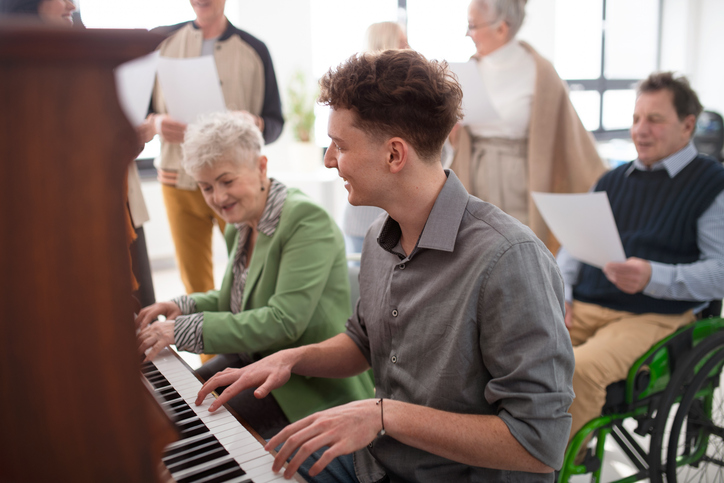
Retirement not only strengthens bonds with family and friends but also fosters greater engagement with wider social groups and the community
Retirement affects much more than income. It can shape health, well-being, and daily life in profound ways. Yet one important aspect is often overlooked: its effect on social capital, meaning the relationships, networks, and community ties that help people stay connected to others. Retirement is usually discussed as an economic or labour-market event, but it is also a major social transition that changes how people spend their time and relate to those around them.
Using nationally representative longitudinal data from Australia, our research examines how retirement influences social capital. We take advantage of differences in the age at which people become eligible for the Australian Age Pension. By comparing individuals who retire when they become eligible with similar individuals who continue working, we find that retirement leads to a meaningful increase in social capital, especially in social connectedness and civic engagement.
One likely reason is that retirement changes the way people use their time. Leaving paid work frees up time that can be devoted to maintaining relationships, building new ones, and taking part in community activities. Importantly, we find that retirement strengthens both close personal ties and wider social connections. In other words, retirement not only deepens relationships with family and friends, but also encourages broader interaction with other groups and with the community.
These gains do not seem to be limited to the first months or years after leaving work. Social capital continues to increase with time spent in retirement, suggesting that retirement is not a single event but a gradual process of social adjustment. Our results also suggest that this increase in social capital is one way retirement improves physical and mental health, with effects similar in size to those associated with physical activity. By contrast, we do not find evidence that retirement changes social trust. This suggests that retirement more easily affects what people do and how they engage with others than their deeper beliefs and attitudes.
These findings matter for public policy. In Australia, as in many other countries, pension reforms are encouraging people to stay in work for longer. Such reforms may support labour supply and help public finances, but they may also postpone some of the social and health benefits that come with retirement. This does not mean that later retirement is necessarily a bad thing. It does mean, however, that its broader effects should be taken seriously.
Policies that promote active aging, such as support for volunteering, community participation, and social engagement, can help offset these costs, especially when people are expected to work longer. Retirement should therefore be understood not only as an economic transition, but also as a social one. Recognizing this is essential if we want policies that support well-being later in life.
© Kadir Atalay, Anita Staneva, and Rong Zhu
Kadir Atalay is Professor at University of Sydney, Australia
Anita Staneva is Senior Lecturer at Griffith University, Australia
Rong Zhu is Senior Lecturer at Flinders University, Australia, and IZA@LISER Research Fellow
Please note:
We recognize that World of Labour articles may prompt discussion and possibly controversy. Opinion pieces, such as the one above, capture ideas and debates concisely, and anchor them with real-world examples. Opinions stated here do not necessarily reflect those of the LISER.
Related World of Labour content:
https://wol.iza.org/articles/the-complex-effects-of-retirement-on-health by Andreas Kuhn
https://wol.iza.org/articles/retirement-plan-type-and-worker-mobility by Colleen Flaherty Manchester
https://wol.iza.org/articles/pension-reform-and-couples-joint-retirement-decisions by Laura Hospido
https://wol.iza.org/articles/effect-of-early-retirement-schemes-on-youth-employment by René Böheim and Thomas Nice
Photo by Halfpoint on iStock