
Livelihoods and food security were hit hardest by the abrupt termination of USAID funding, especially in communities least able to afford it
In January 2025, the Trump administration directed an immediate stop to all USAID-funded activities worldwide: no phase-down, no warning to the local staff, clinics, warehouses, food-distribution networks, and implementing partners built up over decades. For many communities, this meant the sudden loss of salaries, transfers, food assistance, and services on which households and local economies had come to rely. For economists, it also created a rare natural experiment, analysed in our recent IZA@LISER Discussion Paper: an abrupt cut driven by US domestic politics rather than by conditions on the ground in Africa.
To trace its effects at a spatial granularity and temporal frequency that official statistics cannot provide, we used two independent, near-real-time measurement systems. The first is satellite imagery: at night, economic activity glows, and brightness seen from orbit tracks local economic activity. The second is the humanitarian community’s own food-security maps. We matched both to data on where USAID had spent money before the shutdown: 1,374 project sites across 50 African countries in 2017–2020 and compared conditions before and after the stop-work order.
The lights dimmed. Within one kilometre of a typical USAID site, nighttime brightness fell by about six percent relative to its prior trajectory, implying a local economic contraction of roughly 1.4 percentage points a year. The effect was tightly local: it faded with distance and vanished by twenty-five kilometres, a pattern that is difficult to reconcile with a general country-wide downturn. It also appeared as a sharp drop at the date of the shutdown.
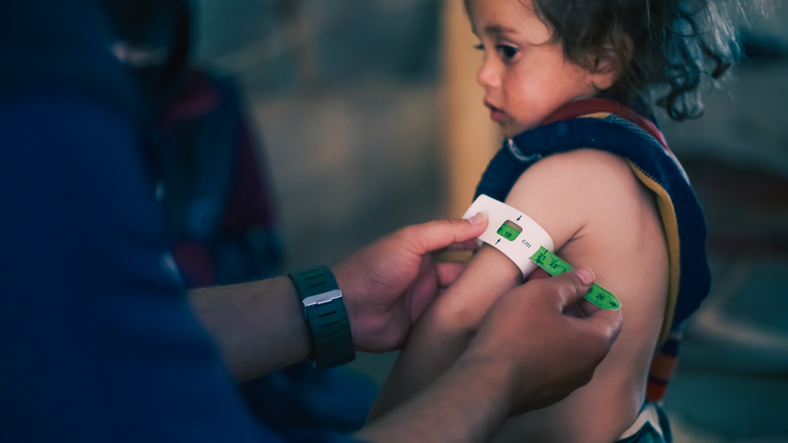
Hunger followed. By September 2025, our estimates imply that the shutdown had pushed roughly 2.7 million additional people into acute food crisis, and about 1.6 million of them into emergency-level food insecurity, relative to a scenario in which aid had continued. The harm built through the year, as warehouses emptied and cash-transfer pipelines ran dry.
The food-security effect was concentrated in countries with weaker institutions. In the less democratic half of the continent, the estimated effect was roughly fourteen times larger than in the more democratic half. The shock landed precisely where governments were least able to step in.
The damage came mainly from the most operational parts of the USAID portfolio: emergency relief, food and cash distribution, and agricultural support. Health programs, including PEPFAR, the long-standing US initiative that funds HIV/AIDS treatment for millions of people across Africa, showed no measurable effect within our fifteen-month window. This should not be read as evidence of no health consequences. Such effects may unfold over longer horizons than our data can capture.
There is a legitimate debate about how much rich countries should spend on aid. Our findings do not settle it. They speak to a different and policy-relevant question: what happens when a large aid infrastructure is withdrawn abruptly rather than through a managed transition. A managed wind-down would have given governments, local organizations, beneficiaries, and other donors time to adapt. The abrupt stop offered no such margin, and it imposed measurable costs on livelihoods and food security precisely where people could least afford them.
© Marcella Nicolini and Fabio Sabatini
Marcella Nicolini is Associate Professor at the University of Pavia, Italy
Fabio Sabatini is Professor at Sapienza University of Rome, Italy, and IZA@LISER Research Fellow
Please note:
We recognize that World of Labour articles may prompt discussion and possibly controversy. Opinion pieces, such as the one above, capture ideas and debates concisely, and anchor them with real-world examples. Opinions stated here do not necessarily reflect those of the LISER.
Photo by Mohammad Bash on iStock