
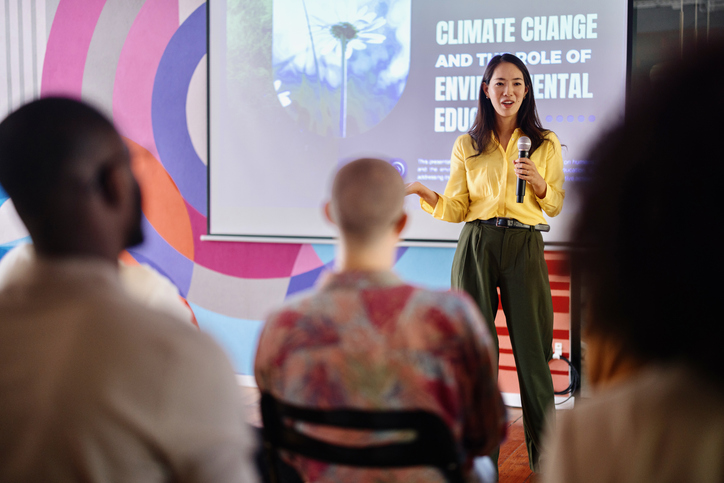
Training can strengthen participants' knowledge, confidence, and support for climate action, while encouraging reflection on carbon-intensive behaviours
Climate change is one of the defining challenges of our time. Yet many people still have only a limited understanding of both the causes of climate change and the policies designed to address it. Misconceptions about climate science and climate policy continue to shape public opinion, influence political debate, and slow the transition to a low-carbon economy.
Providing reliable information at scale is therefore a major policy challenge. Most previous research has examined the effects of information about economic issues and policies through survey experiments, where respondents devote a few minutes of their attention to receive carefully designed information and are questioned immediately afterwards. While these studies show that information can change beliefs temporarily, they tell us little about whether information can reach large populations and have persistent effects. Our recent study asks precisely this question: can substantial information about climate change and policy be delivered effectively at scale through the school system? We find that it can.
Schools offer a unique opportunity to improve climate literacy among future voters, workers, and decision-makers. They also reach adults in their roles of teachers or parents. Although climate-related topics are increasingly included in school curricula, implementation often depends on the initiative of individual teachers or schools. As a result, there is little evidence on the impact of introducing climate education systematically.
Italy provides an ideal setting to study this question. In 2020–2021, a reform of the civic education curriculum introduced climate change as a compulsory topic in all schools and grades. To accompany the reform, we developed a free online course covering both the science of climate change and the economics of climate policy and trained more than 9,300 teachers from over 2,800 secondary schools.
To measure the impact of the programme, we randomly assigned teachers to receive the training at different times and surveyed both teachers and students before and after the course. Before the intervention, knowledge of climate change, particularly of climate policies and their economic implications, was limited among both groups. Teachers themselves reported feeling insufficiently prepared to teach these topics, despite their willingness to do so.
The training produced substantial improvements. Teachers and students became better informed about the causes of climate change, gained a more accurate understanding of climate policies and their likely effects, and reported feeling more confident discussing these issues. Better information also translated into changes in attitudes. Participants updated their views about the effectiveness and distributional consequences of climate policies and support for them, and teachers reported reconsidering some carbon-intensive behaviours, such as flying.
Our study provides encouraging evidence that climate education can be successfully implemented on a large scale through existing school systems. At a time when many governments are seeking ways to strengthen public support for climate action, investing in high-quality climate education may prove to be one of the most effective long-term policy tools. By increasing knowledge, climate education can help citizens better understand the trade-offs involved in climate policy and make more informed decisions as voters, consumers, and future leaders.
© Stefano Carattini, Pamela Giustinelli, and Marcella Veronesi
Stefano Carattini is Associate Professor at Georgia State University, US
Pamela Giustinelli is Associate Professor at University of Padova, Italy, and IZA@LISER Research Fellow
Marcella Veronesi is Professor at University of Turin, Italy
Please note:
We recognize that World of Labour articles may prompt discussion and possibly controversy. Opinion pieces, such as the one above, capture ideas and debates concisely, and anchor them with real-world examples. Opinions stated here do not necessarily reflect those of the LISER.
Related World of Labour content:
https://wol.iza.org/articles/climate-change-and-the-allocation-of-time by Marie Connolly
https://wol.iza.org/articles/climate-change-natural-disasters-and-migration by Linguère Mously Mbaye and Assi Okara
https://wol.iza.org/articles/temperature-productivity-and-income by Olivier Deschenes
https://wol.iza.org/articles/does-hot-weather-affect-human-fertility by Alan Barreca