
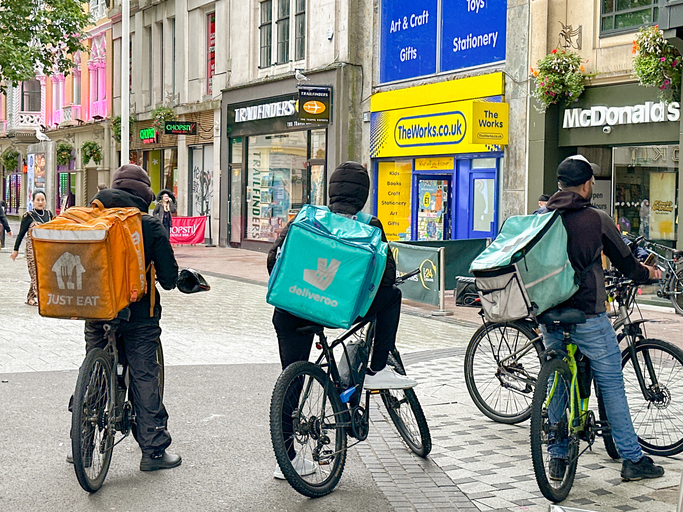
Gig jobs offer low-barrier employment, helping disadvantaged workers enter the labor market and reducing crime and reoffending.
Finding work can be particularly difficult for young people and people of immigrant origin. In France, both groups face disproportionately high unemployment and inactivity. For people with criminal records, barriers to employment can also make it harder to move away from crime. Could easier access to work help?
Food-delivery platforms offer a relatively accessible route into paid work. Registration is free, upfront investment is limited, and applicants need no CV, educational credentials, or formal language qualifications. These features can reduce some of the barriers associated with conventional recruitment. Criminal-record screening also allows many people with previous convictions to work as riders, while excluding those with the most serious records.
Access to these jobs could reduce crime in two ways. Legal earnings may make illegal activities less attractive. Time spent working may also leave fewer opportunities to offend.
In a recent study, we examined these possibilities using the gradual rollout of Uber Eats and Deliveroo across France. Drawing on administrative data from 2012 to 2019, we compared changes in areas where platforms began operating with those in areas where they had not yet arrived or did not operate during the study period.
Platform entry increased delivery-worker registrations and reduced male unemployment. It also reduced inactivity most strongly among foreign-born men. Six in ten riders had no job in the month before registering, and for one in four, delivery work was their first formal job. Together, these findings suggest that platforms brought people with limited access to employment into paid work.
The effects extended to crime. We estimate that police-recorded crime fell by about 4.7 percent after platform entry, relative to comparison areas. Street drug dealing and petty theft declined, consistent with legal earnings making these activities less attractive. Vandalism also fell, suggesting that time spent working may have reduced opportunities to offend. By contrast, we found no statistically detectable change in burglary or vehicle theft, offenses that typically require more specialized skills.
Two further findings strengthen the evidence that access to work matters. The first concerns age. Riders must be at least 18 to register for delivery work. After platforms entered an area, court-recorded property destruction and petty theft fell by 8-9% among young adults aged 18-25, but showed no detectable decline among minors aged 15-17. These offenses are at least as common among minors, making the difference informative. The reduction was concentrated among those old enough to access the new jobs.
The second finding concerns eligibility. Reoffending fell by 13% among people whose criminal records allowed them to work as riders, while changing little among those whose records excluded them. This adds European evidence to a literature on employment opportunities and reoffending that has largely focused on the US.
Our findings suggest that making legal income opportunities more accessible can help reduce crime, even when the work is flexible, temporary, and low-paid. Such jobs can offer an entry point for people excluded from conventional employment. The longer-term policy challenge is to connect that entry point to opportunities to build skills and move into stable work.
© Hugo Allouard, Grazia Cecere, Jose De Sousa, Olivier Marie, and Ines Picard
Hugo Allouard is Assistant Professor at Institut Mines Telecom, Business School
Grazia Cecere is Dean of Research at Institut Mines Telecom, Business School, France
Jose De Sousa is Professor at the University of Paris Pantheon-Assas, France
Olivier Marie is Professor at the Erasmus University Rotterdam, Netherlands, and IZA@LISER Research Fellow
Ines Picard holds a PhD in Economics from CREST, Institut Polytechnique de Paris, France
Please note:
We recognize that World of Labour articles may prompt discussion and possibly controversy. Opinion pieces, such as the one above, capture ideas and debates concisely, and anchor them with real-world examples. Opinions stated here do not necessarily reflect those of the LISER.
Related World of Labour content:
https://wol.iza.org/articles/the-gig-economy by Paul Oyer
https://wol.iza.org/articles/crime-and-immigration by Brian Bell
https://wol.iza.org/articles/active-labor-market-policies-and-crime by Torben Tranaes