
Elevator pitch
Brain drain refers to the selective emigration of highly educated people, who often have stronger incentives to migrate and face fewer barriers. At first glance, this seems to be an adverse situation: losing doctors, engineers or teachers could hinder development. However, migration can also be beneficial by spurring investment in skills, fueling remittances, fostering innovation, business links, and transfers of knowledge and norms. The net impact depends on the skills involved and the context, creating an opportunity for policies that transform emigration into a driver of development.
Key findings
Pros
Selective emigration raises incentives to invest in higher education and training in developing countries.
Remittances improve household welfare and often finance education or productive local investments.
Diaspora networks and returnees promote trade, foreign investment, transfers of knowledge and social norms.
Recent evidence suggests that many developing countries experience net gains from selective emigration.
Cons
Skilled outflows can create shortages in critical sectors such as health and education.
Short-run fiscal losses arise, especially when publicly funded graduates emigrate permanently.
Brain gain outcomes are less likely in remote regions with limited schooling capacity.
Author's main message
After two decades of research, there is an increasing amount of evidence that supports the brain gain hypothesis for many developing countries. This contradicts earlier fears of brain drain. Selective emigration can stimulate education, increase incomes and improve well-being in various ways, but these outcomes depend on factors such as access to quality schooling and migration costs. By shaping these conditions, policymakers can ensure that mobility drives development. Pilot programmes that link education and training to legal migration pathways could provide evidence before being scaled up.
Motivation
International migration is a selective process. Individuals with higher education are more likely to emigrate, particularly from low- and middle-income countries. This “brain drain” is often viewed as a threat because it can deprive sending countries of the human capital necessary for growth, public services, and political accountability. However, the effects are not one-sided. Migration increases the value of education, encouraging skills acquisition at home. Emigrants send remittances, foster trade and investment, and transfer knowledge and norms. Sometimes they return with capital and experience. The net impact depends on the profiles of migrants, their integration at the destination, and local conditions—such as educational capacity and institutional quality. For many developing countries with high financial constraints but substantial potential benefits, selective emigration represents a dual reality: a risk of human capital loss and an opportunity for broader development.
Discussion of pros and cons
Selective migration refers to international migration that is positively selected by education or skill level, meaning that individuals with higher education are more likely to emigrate than those with lower education. Once framed mainly as “brain drain,” causing fiscal losses and shortages, it is increasingly recognised as a potential “brain gain.” Migration prospects can encourage education and create broader benefits—from remittances and return migration to education incentives, business networks, trade, and norm diffusion. This article discusses how these channels collectively reshape development and poverty, and how smart policies can transform risks into opportunities.
Global map of selective migration: who leaves, and in what occupations?
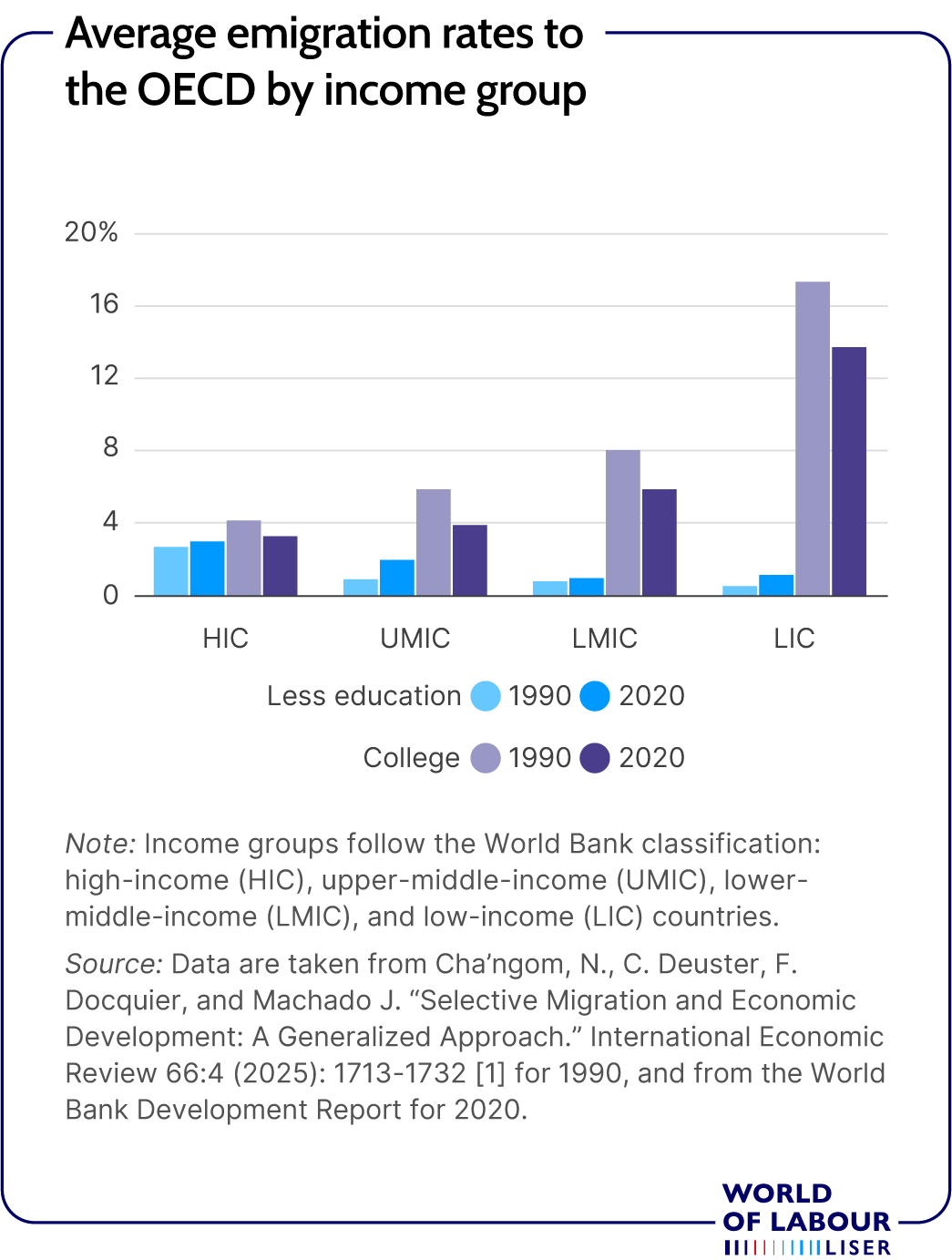
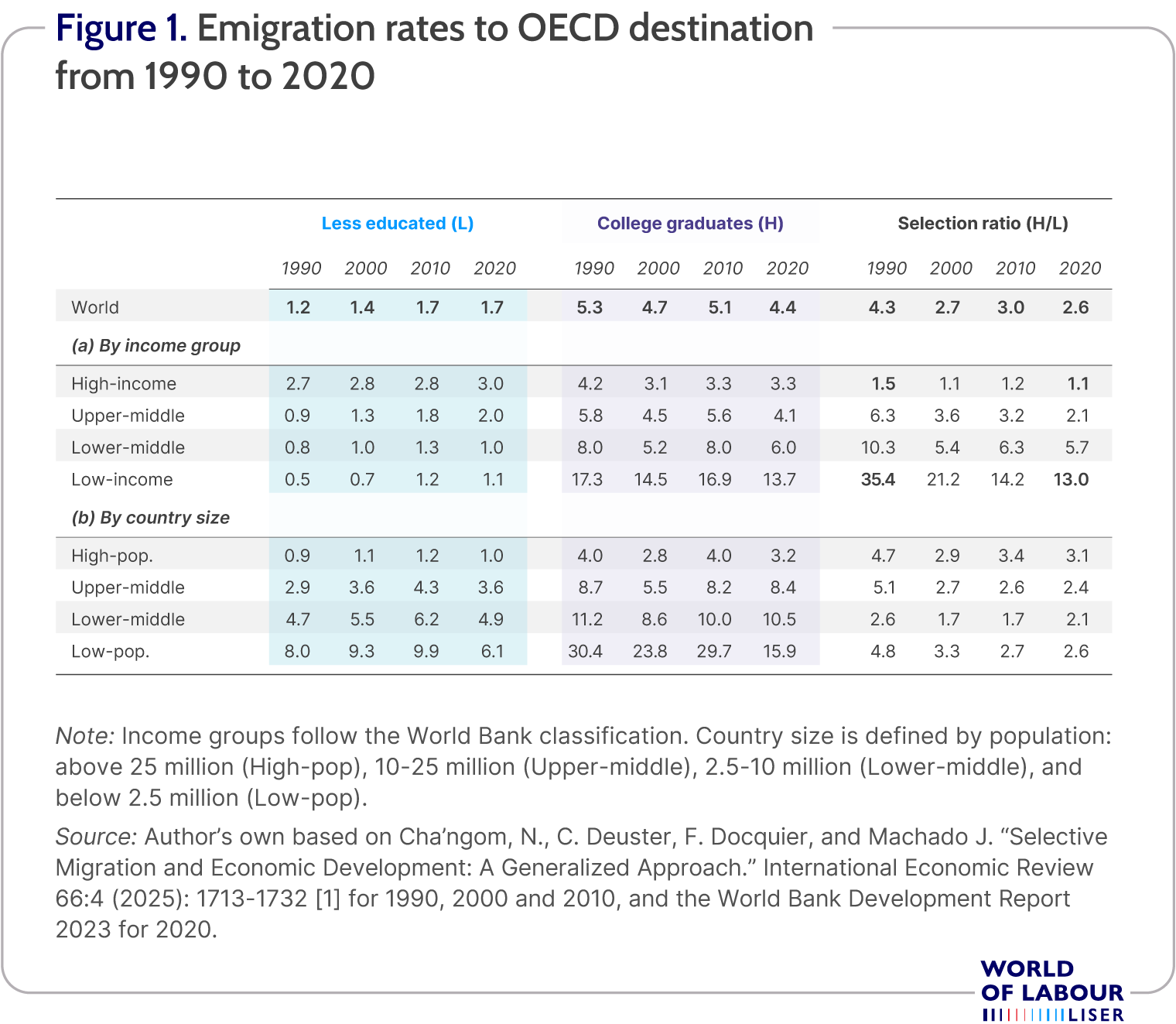
Selective migration is widespread, with college-educated individuals being far more likely to emigrate than those with less education. Cross-country evidence shows that high-skill emigration rates to OECD destinations range from 10% to 50% in most low-income countries and exceed 70% in many small island developing states. High-skill emigration rates decline with development, while low-skill emigration follows an inverted U-shaped curve [1]. The selection ratio (the ratio of high- to low-skill emigration rates) is highest in low-income countries, decreasing from 35.4 in 1990 to 13.0 in 2020, and lowest in high-income countries, decreasing from 1.5 to 1.1—see Figure 1. Across all education groups, emigration rates decrease with country size, reflecting greater internal mobility opportunities in larger economies.
Case studies complement these facts. Certain occupations are especially overrepresented—top academics, inventors, scientists, engineers, and medical professionals are disproportionately abroad [2]. For instance, one-third of Ghana’s doctors have emigrated, 91% of Ethiopia’s PhD holders live overseas, and the Philippines has experienced large outflows of nurses. In some countries, up to two-thirds of graduates from elite software engineering programmes leave. These examples highlight strong positive selection in migration by education and skill levels.
Early views: brain drain as a development threat
Early studies—pioneered by [3]—framed selective emigration as a depletion of scarce human capital, which has negative consequences for economic growth and state capacity. Since education in origin countries is often publicly subsidised, the departure of graduates implied fiscal losses. Taxpayers finance schooling, yet skilled migrants earn and pay taxes abroad, thereby shrinking the domestic tax base while education costs remained high. These studies also emphasised the consequences of weakened provision of essential public services, especially in health and education, reduced innovative capacity, and political costs if potential reform leaders emigrated. Although these mechanisms had limited empirical validation until the early 2000s, limiting brain drain was nonetheless considered intuitively essential to sustaining economic development.
From drain to gain? Education incentives under the microscope
A competing mechanism emphasises incentives: when the returns to education increase with selective emigration prospects, more people invest in education ex ante. Some of those induced to increase their investment in education with the prospect of migrating end up not doing so (or later return), raising the domestic stock of skills despite outflows. Theory formalised this “incentive effect” in stylised two-country models [4], and recently in a generalised setting that accounts for multiple international and internal destinations [1]. This line of work clarified the conditions under which selective migration can generate a net increase in human capital in the origin country.
Causal assessment of these theoretical hypotheses is difficult as the counterfactual is rarely observed: what would education and labour outcomes have been without the migration option? Migration opportunities depend on conditions in the country of origin, and education choices that mainly respond to foreign demand may not always match local needs. This is why strong evidence requires research designs that use external shocks to carefully isolate cause and effect.
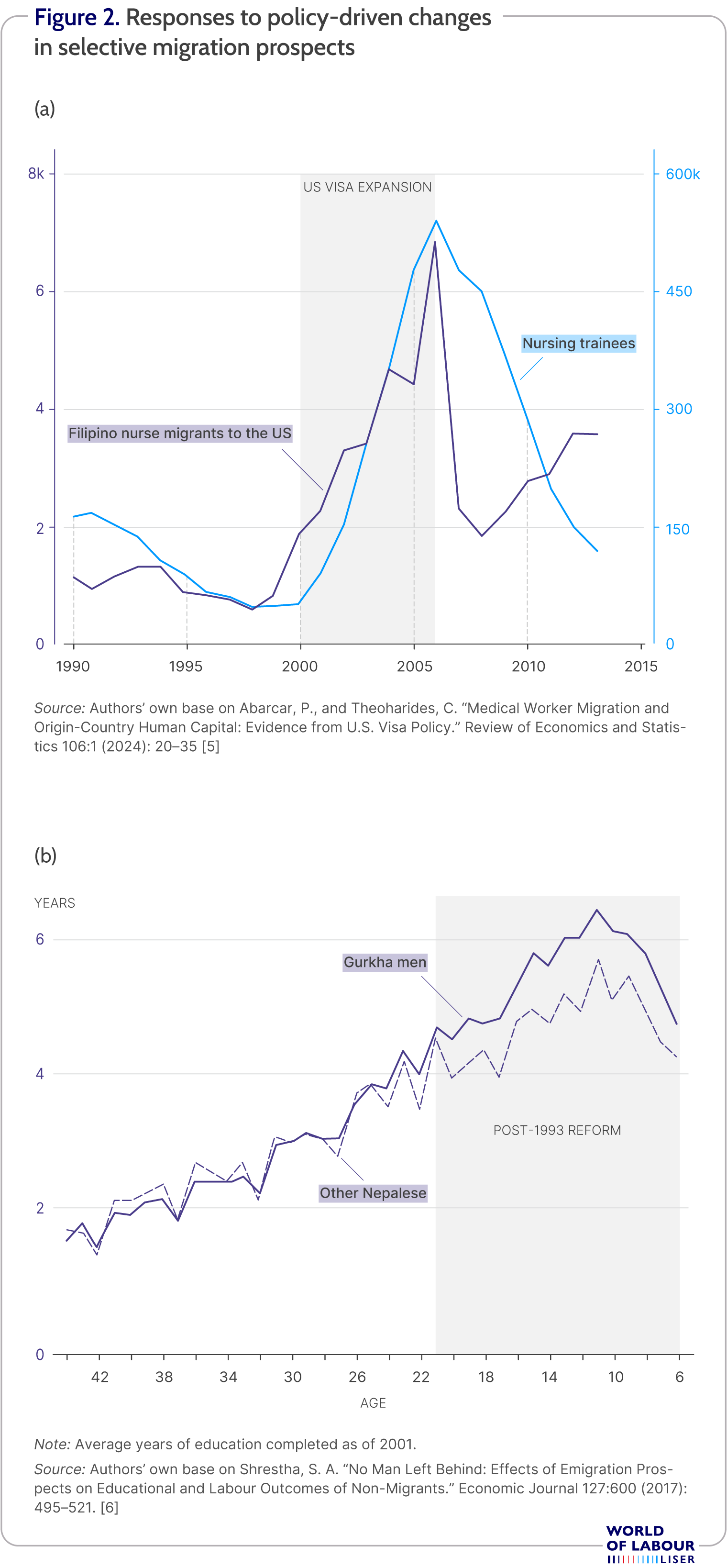
Recent empirical work made progress, as reviewed by [2]. It demonstrates that foreign policy reforms that increase opportunities for high-skilled migration can enhance a country's human capital. For example, expanded US nursing visas in the Philippines triggered a surge in nursing programme capacity and enrolment, increasing the number of licensed nurses at home even as many emigrated—evidence consistent with a substantial net domestic increase in skills [5]—see Figure 2(a). In Nepal, analysis of the impact of a 1993 reform introducing minimum education requirements for Nepalese recruits into the British Gurkha Army is presented in [6]. This policy primarily affected men from the Gurkha ethnic group, creating a plausibly exogenous increase in selective emigration prospects. In response, Gurkha men invested more in education, leading to a net rise in human capital at origin. By 2001, average schooling among Gurkha men had increased by 1.19 years, improving domestic labour market outcomes even for those who did not migrate—see Figure 2(b).
Further evidence of such brain gain effects was found in India, the Fiji Islands, Tonga, Papua New Guinea, New Zealand, and Cape Verde. Other studies also show that remittances from migrants—caused by external policy and exchange rate shocks—as well as the transfer of norms, increased long-term human capital investment in Malawi, the Philippines, and early 20th century Galicia.
Cross-country studies also reveal a positive association between selective emigration and education in poorer countries. The most recent studies confirm these findings by instrumenting the high-minus-low skill emigration differential with external shocks, and allowing for heterogeneous responses by income group [1]. In low- and lower-middle-income countries, migration prospects are associated with increased education investment, whereas the effects weaken or disappear at higher income levels, which is consistent with tighter constraints and larger migration premiums in poorer settings. The key finding is that the “brain gain” mechanism operates in many low- and lower-middle-income countries within a decade of migration shocks. However, the long-term impact on global human capital disparities is rather small.
Overall, case studies and cross-country analyses converge on three key points. First, migration opportunities provide strong incentives to study and train in many developing countries. Second, results depend heavily on context, including the capacity of education systems, the mix of destinations, national regulations, and country size. Third, to measure the impact on economic development, not only the human capital response should be considered, but also broader spillovers should be taken into account.
Beyond human capital: financial flows, ideas, and norms in motion
The focus therefore shifts to the spillovers of selective emigration—as reviewed in [2]. Remittances are the most direct channel through which this occurs. Higher foreign incomes finance household consumption and savings in the country of origin, which often cushions economic shocks. They also finance productive investments, such as education and business investments.
Return and circular migration also transfer skills, managerial practices, and technology back home, with selective temporary programmes magnifying this effect. Evidence includes returnees improving corporate governance, institutional quality, and productivity, as well as alumni programmes increasing knowledge diffusion. Furthermore, migrant links affect trade. Studies that exploit variations in refugee and ethnic networks document a significant increase in bilateral exports and imports when these links expand, with larger effects for more skilled diasporas.
Business networks and foreign investment follow a similar pattern. Diasporas reduce cross-border transaction costs, connect suppliers to markets, and channel capital and expertise, thereby raising productivity. Studies using causal designs show that larger migrant networks increase manufacturing output, patenting, and offshoring. In the IT sector, returnees fueled industry growth and participation in global value chains. Short-run losses can occur: firm productivity may decline as skilled workers depart, and outflows during recessions can hinder new firm creation before the long-term benefits of networks materialise. The timing, migrant type, and conditions at the origin—market size, stability, investment climate—shape the sign and magnitude of these effects. Nevertheless, diaspora-driven channels contribute to knowledge diffusion, productivity growth, and shifts in the comparative advantage of nations in the medium to long term.
Migrants also transmit democratic and behavioural norms: they carry political attitudes and behaviours from destination, as well as health behaviours and gender norms. Regions of origin with migrants in more democratic countries often exhibit stronger support for democratic practices and improved governance. Exposure to more liberal reproductive health policies abroad can reduce fertility rates, lower infant and maternal mortality rates, or increase women’s decision-making power within households. These “political remittances” and social norm transfers act partly through diaspora networks and media. The effects accumulate over time and depend on the type of norms in the destination regions. Equally important for the transmission of these social remittances is the quality of immigrant integration at destination.
Putting it all together: development accounting insights
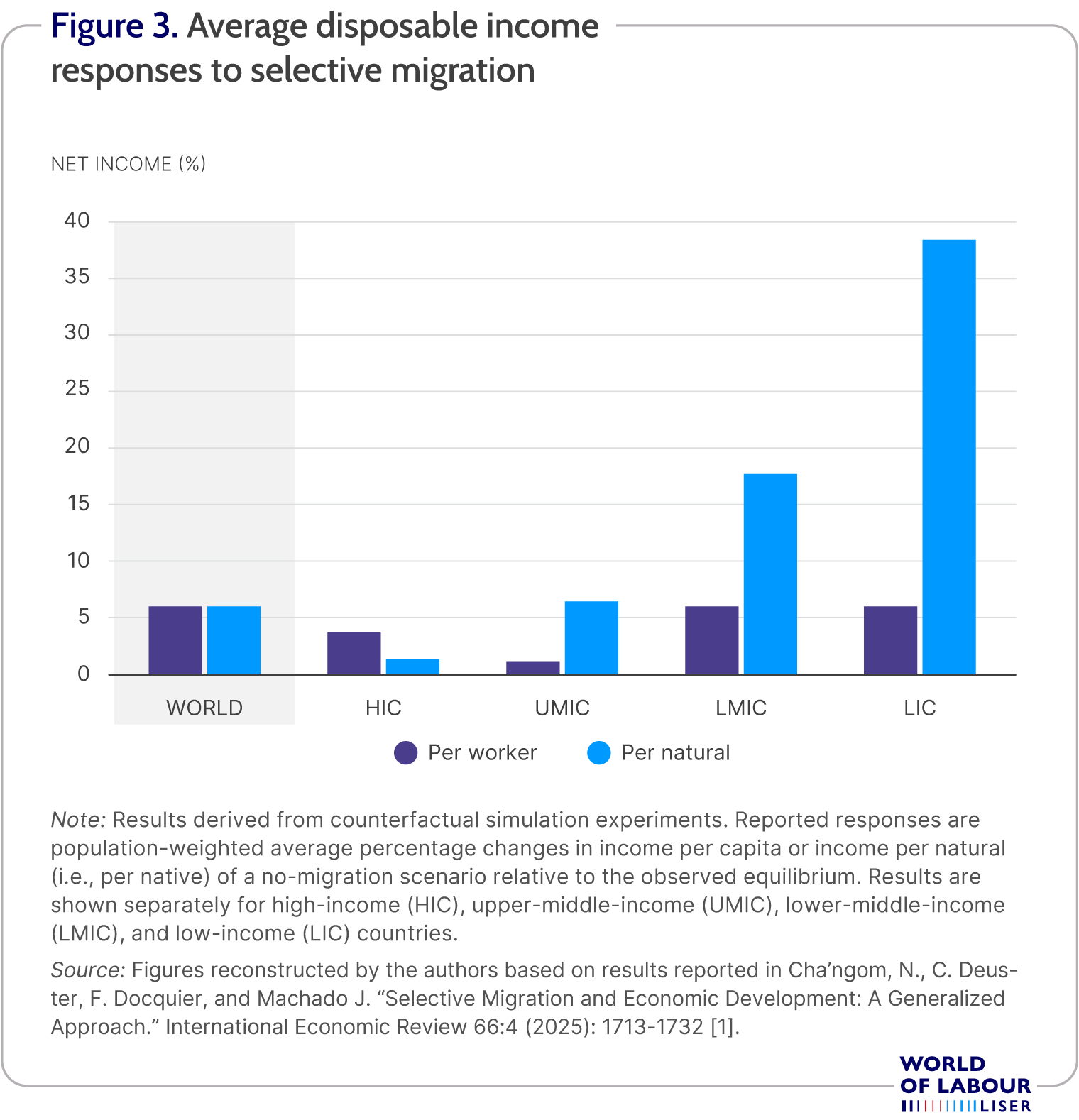
A unified macroeconomic model is needed to contrast the adverse mechanisms highlighted in early studies (complementarities between high- and low-skill labour, fiscal externalities, and the possibility that selective emigration reduces market size and entrepreneurial variety) with beneficial spillover effects (including brain gain incentives, remittances, and diaspora-driven gains). While much of the existing evidence focuses on specific mechanisms and case studies, the overall developmental impact of selective emigration can only be assessed by aggregating these effects at the macroeconomic level. The model developed in [1] compares the observed world with a no-migration counterfactual equilibrium. The results are presented in Figure 3.
Quantitatively, selective emigration increases disposable income per worker in a large majority of origin countries, especially among the least developed, despite positive selection. Emigration itself contributes to income convergence across countries. Most countries experience gains in the range of 0–20%, while 15 countries show even larger effects: Jamaica, Guyana, Moldova, Comoros, Lebanon, Samoa, Haiti, Fiji, El Salvador, Zimbabwe, Tajikistan, the Philippines, Lesotho, Honduras, and Nicaragua. Negative effects appear in a few (mostly small) countries where access to education is limited and emigrants are negatively or excessively positively selected. Income losses exceeding 2% are observed in six upper-middle-income or high-income island countries: Suriname, Trinidad and Tobago, Grenada, Saint Vincent and the Grenadines, Mauritius, and Barbados.
As expected, convergence effects are substantially stronger when development is assessed at the level of people rather than places. Selective emigration increases income per capita by around 5% in low-income and lower-middle-income countries. However, when measured in terms of income per natural (the average income of a country's natives, regardless of where they reside), the gains are considerably larger: around 35% in low-income countries and 18% in lower-middle-income countries. Upper-middle-income countries also experience significant increases in income per natural. By contrast, the effects are weaker or reversed in richer countries, where some migration involves moving from a very high-income destination to a moderately high-income one.
At the global level, selective migration increases average income by around 5.5%, shifting the entire income distribution to the right. It also reduces extreme poverty (defined as living on less than US$5.50 per day) by around 6%. These findings suggest that the combined benefits of migration, including education incentives, remittances, network effects and the diffusion of norms, more than compensate for potential losses in most countries of origin.
Heterogeneous effects of the brain drain: insights from Senegal
Brain gain outcomes are not automatic. They depend heavily on local conditions such as access to education and mobility opportunities. These conditions vary not only across countries but also within them. A study on Senegal illustrates this point, showing how the balance between brain drain and brain gain differs sharply across regions [7]. Figure 4 shows that Dakar has the highest high-skill emigration rates and the best access to college education by far.
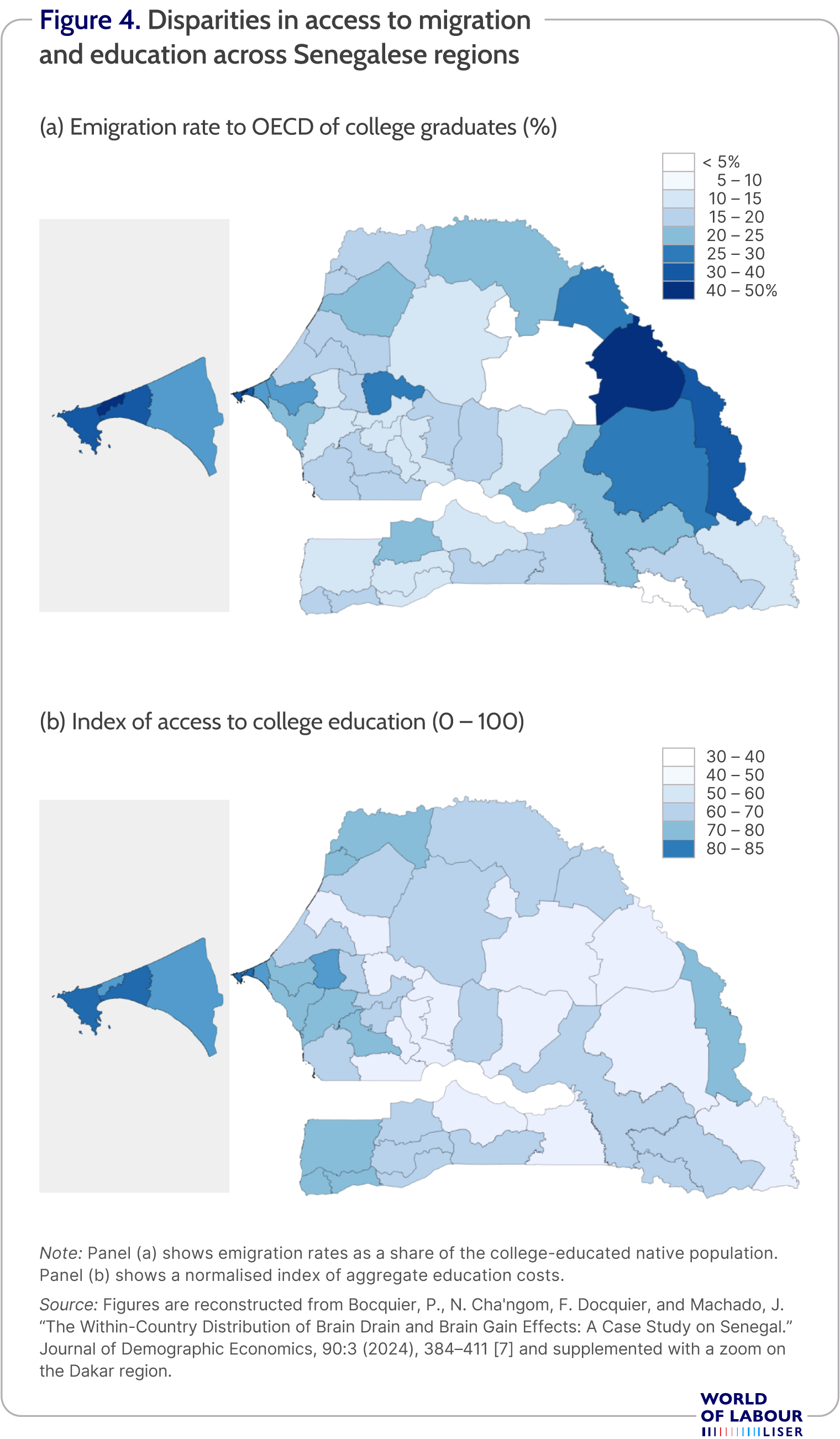
At the national level, selective emigration raises human capital and income. However, wealthier regions, especially Dakar and its surroundings, reap the majority of these benefits. Better access to education and stronger international connections mean that migration prospects create powerful incentives for skill formation locally. Remittances and diaspora networks further reinforce these advantages, making Dakar the main beneficiary— the border regions with Mali also have high emigration rates, but these involve very few college-educated migrants in absolute numbers. Conversely, remote and poorer regions face severe constraints. Vulnerable populations often lack the resources to migrate or pursue higher education, and weak economic development limits their ability to capitalise on migration opportunities. Hence, international mobility exacerbates existing inequalities in both education and welfare. Internal migration can mitigate these disparities, but poor infrastructure and limited labour market integration mean that the poorest regions remain largely excluded. Dakar thus enjoys a “double dividend”: benefits from international migration prospects and an inflow of human capital from other regions. The Senegalese case illustrates the importance of accounting for regional differences when evaluating the developmental impact of migration.
Maximising brain gain effects: informing migrants
Recent randomised experimental evidence shows that using digital tools to deliver information to immigrants after arrival substantially improves their labour market integration, satisfaction, and empowerment [8]. These improvements in immigrant integration, in turn, strengthen the transmission of political and social remittances to their countries of origin. This evidence highlights the importance of investing in policies that improve immigrant integration to maximise the benefits of migration for both countries of origin and destination.
Turning to student migrants, a recent study documents substantial information gaps among prospective international students from Cape Verde to Portugal, leading to poor academic outcomes and underutilisation of skills upon arrival [9]. To evaluate potential policy solutions, the authors conducted a lab-in-the-field experiment showing that prospective college students react strongly to information about graduation rates and financial support. Perceived graduation prospects and funding availability that were deemed favourable increased migration choices in the lab, which correlated well with actual intentions and steps toward migration. Ongoing randomised experiments— on Cape Verde–Portugal student flows and Uganda’s Malengo programme linking students to German universities—will provide further evidence on how information shapes migration decisions and outcomes. Low-cost, easily replicable information campaigns could be a powerful tool for maximising “brain gain” by enabling more informed study choices, higher success rates, and better integration abroad.
Limitations and gaps
Despite substantial progress, important limitations still constrain the understanding of selective migration and its developmental consequences. First, data availability remains limited. While aggregate figures by education level exist, detailed statistics by occupation or industry are scarce. This makes it difficult to determine which professions experience the greatest loss when workers emigrate and which professions benefit the most from knowledge transfer, entrepreneurship, or innovation. For example, the outflow of doctors and IT specialists may have very different implications.
Second, although the number of rigorous causal studies is increasing, they are still only available for a limited number of countries, which are often larger or middle-income. Much of the literature still relies on quasi-experimental designs that exploit migration policy changes or historical variations. While these approaches provide valuable insights, they are often context-specific and may not be applicable elsewhere. More experimental and quasi-experimental evidence is needed in smaller, poorer countries, where conditions differ and the stakes are high.
Third, integrating multiple mechanisms into a single framework remains challenging, even with more robust evidence. Selective emigration simultaneously affects education, remittances, trade, investment, and social or political norms. As discussed above, general equilibrium models capture some of these links; however, they inevitably simplify and often overlook the heterogeneity of institutions, preferences, education systems, and labour markets across sending countries.
Finally, the distributional consequences within origin countries are poorly understood. The gains and losses of migration are not uniform; they may differ by income group, gender, age, or region. For example, households that receive remittances may benefit more, while poorer or rural communities without migrant networks may be left behind. Identifying these inequalities is essential to designing policies that mitigate costs and amplify benefits.
Summary and policy advice
New evidence shows that the developmental consequences of selective migration are highly context-dependent and often more positive than the earlier “brain drain” perspective suggests. Instead of trying to restrict skilled emigration, a strategy that is both unrealistic and potentially harmful, countries and international institutions should focus on maximising gains while limiting losses:
- Education systems must adapt to local and international demand. For example, expanding training capacity in essential fields can transform migration prospects into domestic “brain gain” rather than shortages, as exemplified by Filipino nurses and Indian IT professionals.
- Circular and return migration should be encouraged. Recognising foreign qualifications, offering temporary return incentives, and creating diaspora platforms can channel skills, networks, and investment back home.
- Providing migrants with better information before departure and after arrival is also essential to reducing skill mismatches and underutilisation abroad.
- When combined with financial inclusion, stronger investment climates, and secure property rights, remittances and diaspora links can have a greater impact, enabling entrepreneurship, trade, and innovation.
Finally, the brain-gain logic applies to more than just university graduates [10]. Global Skills Partnerships (GSPs) can link vocational training with legal migration opportunities. By connecting training to labour-market needs at home and abroad, and by opening pathways to migration upon completion, these programmes can increase participation and effort, address skill shortages in destination countries, and strengthen local human capital. Pilot projects in healthcare, hospitality, and construction should test the feasibility, financing, and integration of these programmes. Rigorous evaluations, such as randomised trials or phased rollouts, should be used to measure their impact before scaling them up. Taken together, these measures demonstrate that the real challenge is not stopping mobility, but rather designing policies that transform migration into a lever for human development.
Acknowledgments
The authors thank the anonymous referee(s) and the World of Labour editors for helpful suggestions on earlier drafts. This research was supported by the Luxembourg National Research Fund (FNR) through Grant INTER/Mobility/LE/18952383/DEVMOB_CB, “Evidence for Development Policy: Linking Skills, Entrepreneurship and Migration,” as well as by the Directorate for Development Cooperation and Humanitarian Affairs of the Luxembourg Ministry of Foreign and European Affairs, through its project “Cellule d’Analyse d’Impact des Politiques de Développement.” Version 2 of this article updates all figures, adds new findings, and updates most of the Key references.
Competing interests
The World of Labour project is committed to the European Code of Conduct in Research Integrity. The authors declare to have observed the principles outlined in the code.
© Catia Batista and Frédéric Docquier


