
Elevator pitch
Work on different days of the week is not equally desirable to workers. The same is true for work performed at different times of the day. Undesirable work times are more common among less educated workers, young and quite old workers, minorities, and immigrants. There are substantial cross-country differences in patterns of work timing, with work in lower-income countries distributed more evenly across the week. Policies to affect the timing of work are few, but they do alter outcomes.
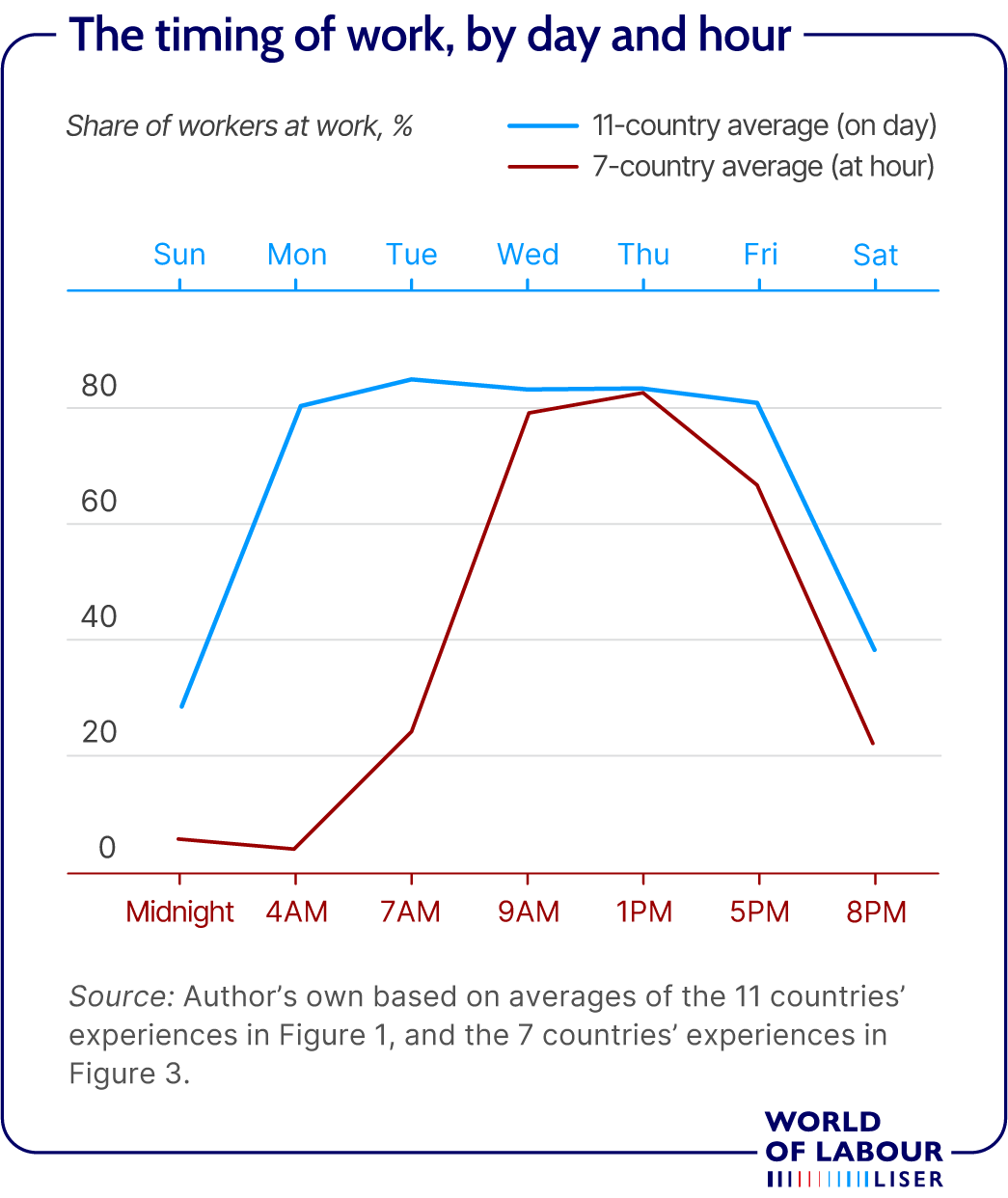
Key findings
Pros
Working on weekends is productive in many industries.
Workers prefer leisure on consecutive days.
A four-day workweek allows workers more consecutive leisure time and reduces commuting costs.
Work in the evenings and at night is productive in many industries.
Increased work at home, as occurred during the Covid-19 pandemic, allows workers temporal flexibility that can increase their well-being.
Cons
People generally dislike weekend work because they cannot enjoy leisure time with their families.
Interspersed leisure across days is more common among less educated workers, immigrants, and minorities.
A four-day workweek might reduce productivity.
Workers find evening/night work to be undesirable.
Work at home makes co-ordination of activities among workers more difficult and can thus reduce productivity.
Author's main message
Modern industries need labour at many different times of the day and week. Yet workers have clear preferences for working at specific times and for arranging the patterns of their workdays and workweeks. Managers need to be aware of workers' preferences for work timing in order to minimize costs and simultaneously retain their employees. This juxtaposition of sometimes opposed needs generates pay differences for work at different times and produces observable demographic differences in who works when.
Motivation
Immense amounts of attention have been given to whether people work—participate in the labour force and, if so, how many hours per week or per year they work. These are important, since people wish to earn income to finance their consumption and wish to enjoy leisure time rather than work. Much less attention has been paid to when people work—which weeks of the year, which days of the week, which hours of the day. Yet people care about when they are working; and employers also care about when their employees are working. Several labour-market policies have been put in place or have been proposed that can alter work timing.
Discussion of pros and cons
Working over the year
Very little if any research has been done on which weeks of the year people work. Except for the US, no time-use data allows inferring the monthly distribution of actual work time. In the US from 2016-19 and 2021-24, the percentage of workers at work on the average weekday in a month ranged from 84 to 87 percent across all months except December, when it was only 78 percent, and July, when it was 82 percent. The former probably reflects time not worked during the Christmas holidays, while the latter is the most common American summer vacation time. These patterns are clearly cultural: French data would undoubtedly show that August, the month of les vacances, would exhibit the lowest percentage at work.
Working across the week
Current, past, and demographics
Very few studies have analysed the determinants of the fraction of a country’s workforce that is on the job on a particular day. Yet weekly schedules of work are likely to be determined by the interaction of employers’ perceptions of the times when employees are likely to be more productive and workers’ desires for working on various days. Figure 1 presents the distribution across the days of the week by people who do any work at all, based on time diaries in each of eleven countries in recent years (using the most recent data for each country from timeuse.ipums.org and timeuse.org/mtus).
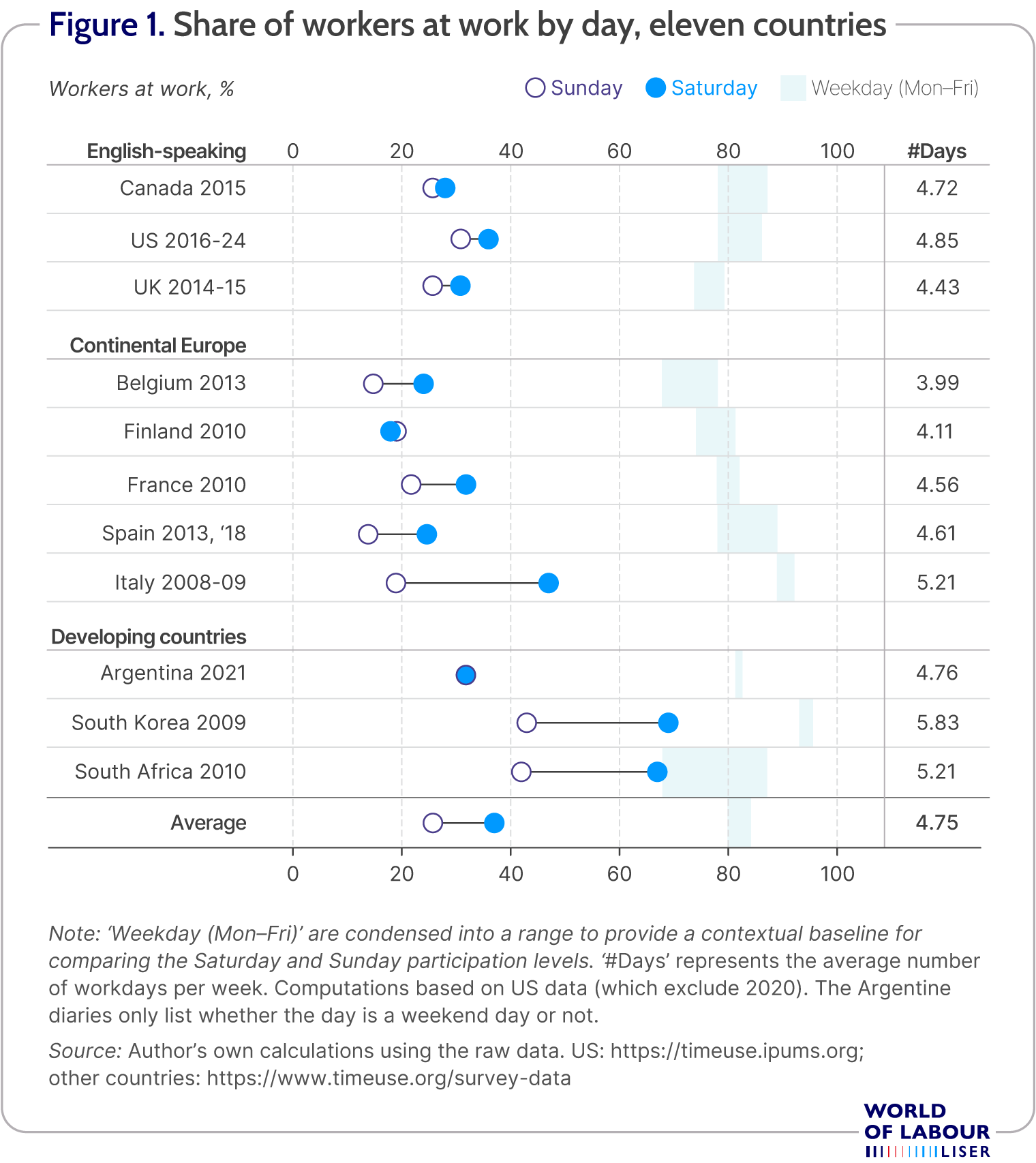
Obviously fewer workers are on the job on weekends. As Figure 1 shows, however, more weekend work is performed in predominantly English-speaking wealthy countries than in continental Europe, and still more is performed in what were middle- or low-income countries at the times when the diaries were collected. The average number of days on which the typical worker was working is remarkably similar across the English-speaking countries, slightly higher in the less developed countries, but remarkably diverse within continental Europe, ranging from not quite four days/worker (Belgium) to over five days/worker (Italy). Given what is known about annual worktime across these eleven countries (quite high in the US, South Korea, and South Africa, lower in southern Europe), days of work (work timing) clearly tell a different story about what people are doing than do weekly or annual hours (amounts of work).
Weekly work patterns differ across demographic groups. Consider differences (in seven of the eleven countries listed in Figure 1) by gender, marital status, age, and education, with each difference holding constant the other characteristics listed. Figure 2 shows the independent effect of each of these characteristics (compared to some base group on the fraction of workers who work on a weekend day). E.g., it presents the difference in the likelihood of weekend work between men and women, married/unmarried, etc., for each country and for the average of all seven countries. The final column lists as a baseline the average fraction of the employed population that works either on Saturday or Sunday.
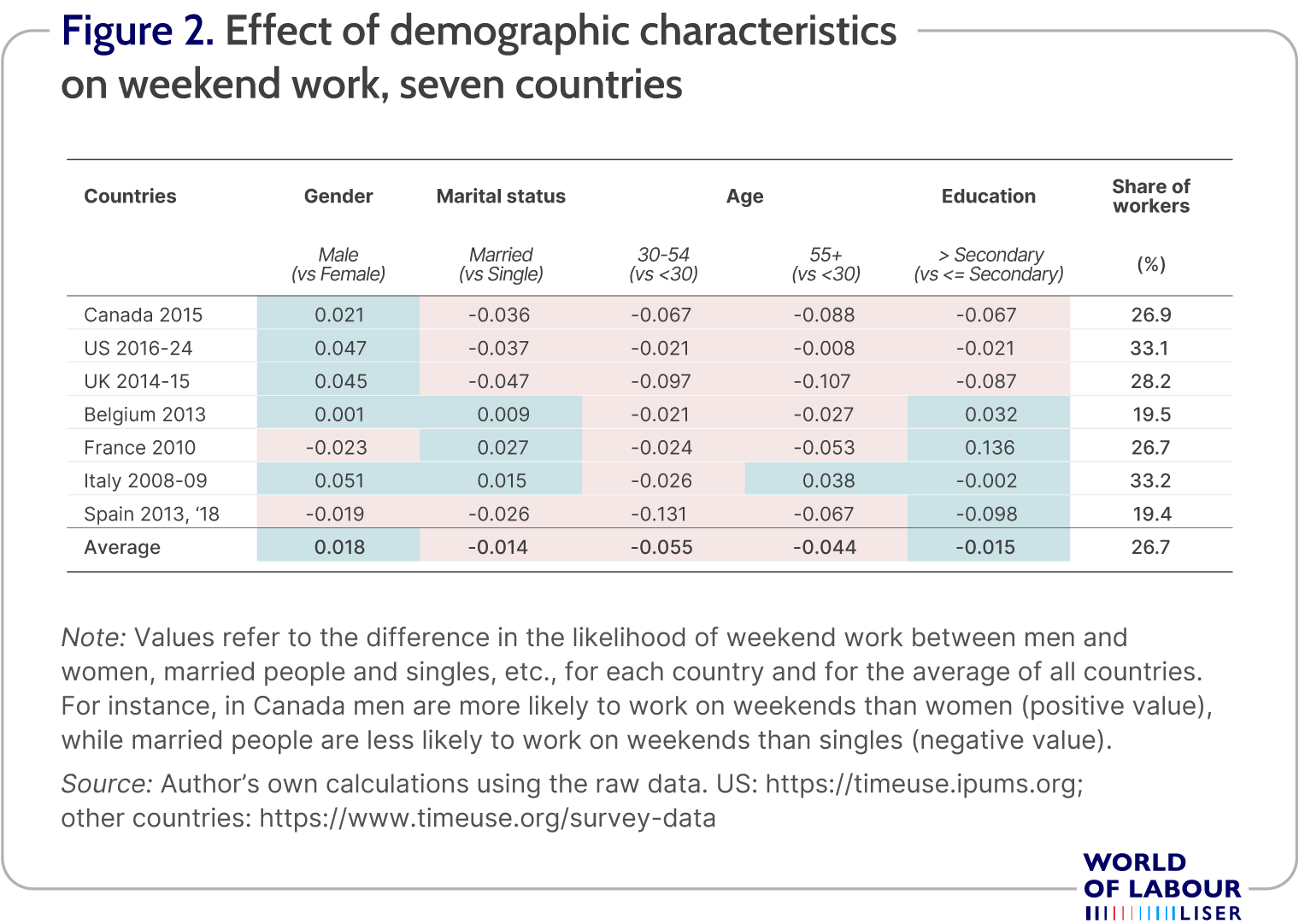
There are sharp differences by age in weekend work: It is the province disproportionately of younger workers. Similarly, less educated workers are more likely than others to be working on weekends, as are unmarried workers and men. Overall, except for the small differences by gender, this suggests that weekend work is especially common among those with less human capital—with lower earnings ability.
Trends and scheduling
Another interesting question is what has happened in the last 50 years to the four-day week, and particularly to the number of days worked by full-time workers. Evidence for the US, the Netherlands, Germany, and South Korea shows that four-day work has become increasingly common [1]. In the US among workers putting in 35 or more hours per week, the percentage working on four days rose from 1% in 1973 to over 5% in 2018. The growth was even more rapid in the Netherlands, from 3% in 1975 to 14% in 2005 among those working 32 or more hours per week.
Among four-day workers the overwhelming fraction work on four consecutive days. Evidence from the Netherlands shows that discontinuous four-day schedules are disproportionately worked by younger workers and those with less education. This is not surprising: A discontinuous schedule prevents leisure from being consumed in chunks and thus prevents workers from scheduling longer holiday and family breaks. Discontinuous work schedules are inferior.
Many workers find a continuous four-day workweek desirable, since aside from allowing longer chunks of leisure time, working one less day per week saves commuting time and money. The evidence suggests that workers pay for those savings by accepting hourly wages that in the US from 1997-2018 were 1% below those received by otherwise identical workers [1]. The small size of this difference is a hint that the market may not fully account for workers’ preferences for scheduling. Employers have an interest in workers’ weekly schedules; with five eight-hour workdays per week being the standard, employers often find it difficult to schedule workers for 40 hours over only four days. That the conflicting preferences between workers and employers are partly resolved by the market through a wage penalty on four-day work suggests that employers’ willingness to supply four-day schedules is less than workers’ desires for them.
Workers prefer certainty—expecting uncertain work timing leads workers to insist on extra pay to accept a job whose timing is uncertain. Employers have incentives to pay more for such work, provided the labour market is sufficiently tight. Difficulties arise when workers and employers do not expect uncertainty, such as when workers expect to report for work, but are told at the last minute not to show up and then receive no pay for that day. This is a common practice in the US, disproportionately among women, the less educated, and those in retail and service industries.
Working across the day
Current, past, and demographics
Data on the daily timing of work are less readily available than those on days worked. Nonetheless, one can gather recent data from seven of the eleven countries whose experiences are depicted in Figure 1. The resulting analyses, presented in Figure 3, list among people who work at all during the week the fraction on the job at that particular hour on a weekday. The fractions are adjusted for international differences in total daily hours worked, so that the results do not arise because workers in one country put in more hours in total per day. Unsurprisingly there is a “typical workday” in all countries, with most workers being on the job from mid-morning to late afternoon in most countries. Work at night is uncommon.
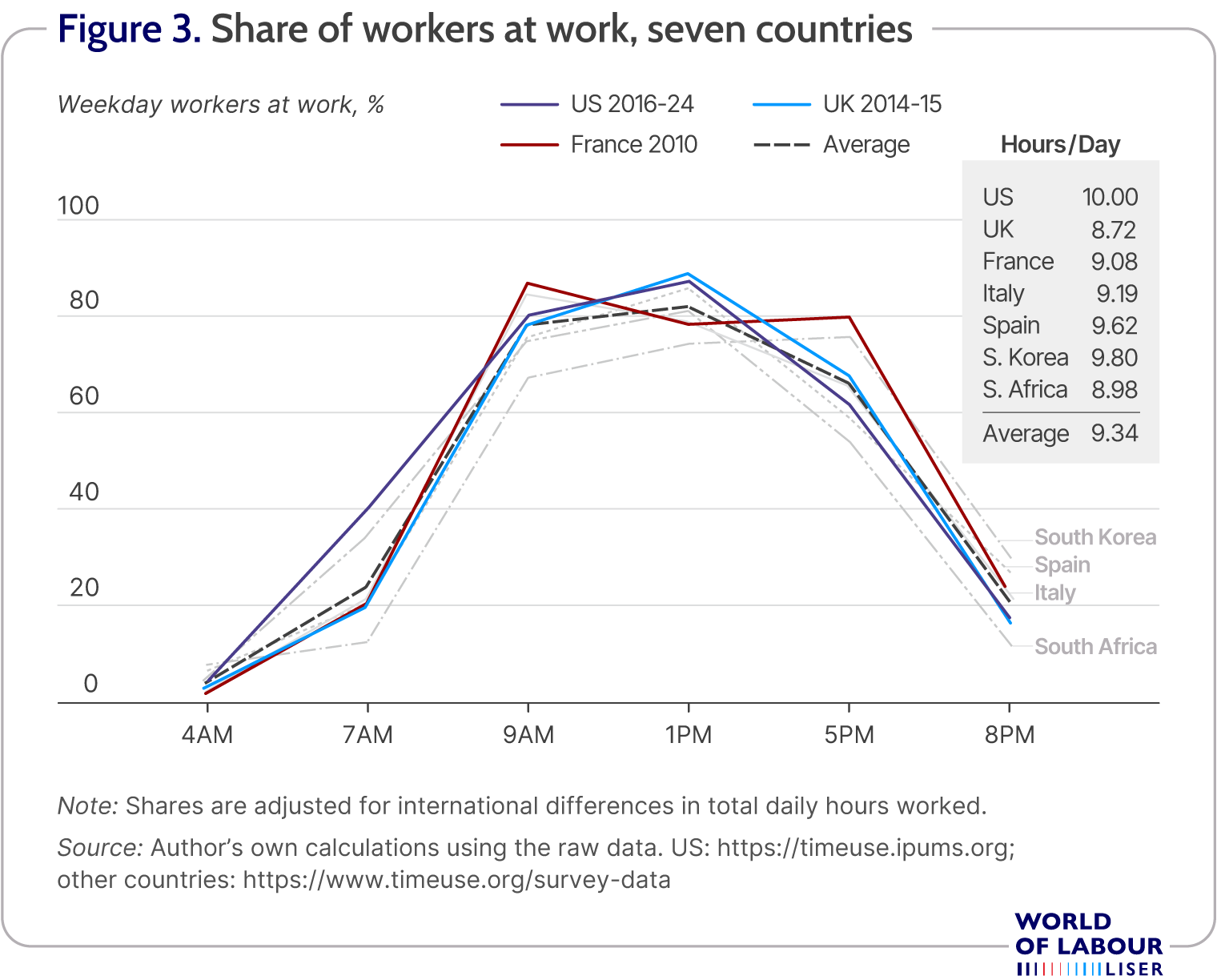
There is substantial international variation. Comparing the US to the four European countries, the American workday starts earlier in the day and generally ends earlier. Thus, there is proportionately less evening work in the US than in Europe, but more work is performed at night.
The paucity of repeated sets of data on daily work timing makes it difficult to examine trends. Nonetheless, this can be done for the US 1973-2023, the UK 1974-2015, and France 1966-2010 [2]. The evidence for the US demonstrates that late night work has been declining, with more work being done at the fringes of the day—early mornings and evenings. Although there have been major changes in industrial structure—the decline in manufacturing, the rise in retail and services—the trend away from night work does not appear to be due to changes in the structure of industry at the level of broad aggregates. Instead, changing demographics have accounted for a large part of this trend. No such trend exists in the UK, but its absence appears to be due entirely to the sharp decline in unionization in the UK. The downward trend also exists in France; but the main change in work timing there is the near disappearance of the mid-day meal at home, so that more work is now performed at the middle of the day.
Night work is generally viewed as undesirable, so that, to induce workers to be on the job at night, employers must and do offer compensating wage differentials for night work [3], [4]. Nonetheless, the market-generated wage differentials for night work are insufficient to attract most workers. Instead, they attract workers for whom the extra pay at night is most important. This fact is demonstrated in the top panel of Figure 4, showing for the five higher-income countries in Figure 3 how demographic differences affect whether a worker is on the job at night (4AM, with similar differences at other night-time hours). In all five countries the less educated—those with lower earnings potential—are more likely to be working at night than others. The opposite is true in the middle of the day—a desirable time to work—as shown in the middle panel by the greater prevalence of work then among the more educated. Family commitments are also important—single workers are more likely to work at night, while women are more likely to work during the day [5]. Prime-age workers are least likely to work evenings, as shown in the bottom panel, again perhaps because of family commitments.
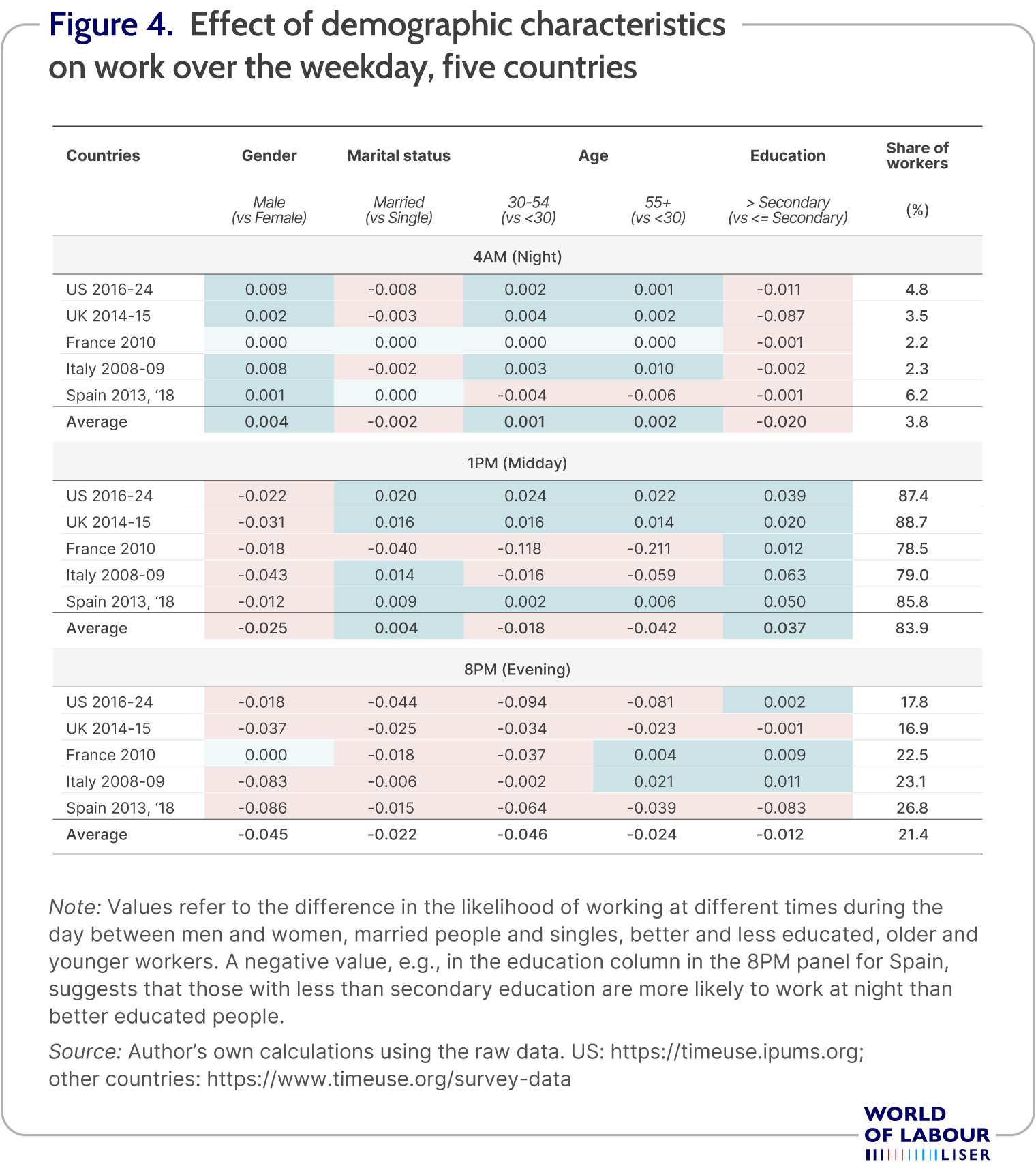
These demographic differences do not arise because workers are employed in different industries that offer different work timing. They result mostly from workers sorting themselves into jobs that offer them the best pay given their other opportunities. The observation that undesirable (night) work is particularly common among those with the lowest earnings potential is consistent with the demographic differences in work on weekends noted above.
This interpretation of the daily pattern of working time also explains the downward trend in night work: As real wages have increased over the past half-century, workers have become less willing to engage in work at undesirable times. Compensating wage differentials for such work have not risen enough to prevent a drop in the incidence of such work, although they have risen [2]. Given the stability over time in the total amount of work performed per year (especially in the US), this preference-based shift away from night work has led to increases in the amount of work at the fringes of the day.
The daily timing of work is not only determined by the preferences of workers and the costs facing employers. It also results partly from an equilibrium across the geography of a country (and perhaps even of the world), as workers in many industries and places need to interact with workers in other industries and locations to produce a good or service. It can thus be observed that in the US work timing in much of the rest of the country is affected by work timing in its most populous section, the Eastern time zone, with a similar phenomenon observed in Australia [6]. Because of this temporal coordination problem, even artificial changes, such as the introduction of Summer Time, alter the time of day when people work, with those in less economically important areas changing the timing of their work, and even their sleeping and eating patterns, to accommodate changes in the timing of work in major economic areas.
Flexibility or irregularity?
In the context of work timing, both flexibility and irregularity imply variable schedules. Yet flexibility puts a positive spin on variability, consistent with evidence for Uber drivers [7] and for workers more generally [8], while irregularity has a negative connotation. The information summarised above, both on days worked and on recalled daily work timing, describes the behaviour of workers with regular schedules. The issue is: Do workers with variable hours view them as flexible and desirable or as irregular and a disamenity of their jobs?
The most recent available data (for the US 2017-18) indicates that 6% of workers state that they have flexible/irregular schedules. 10% of high-school dropouts have variable schedules, while only 5% of college graduates do. Moreover, other evidence (most recently, for the US in 2004), indicates that involuntary schedules account for 2/3 of all variable schedules. This suggests that, while a few workers may prefer the variability implied by flexible schedules that they can choose, most workers on variable schedules do not choose them—they are imposed by employers as a condition of work on those with few alternatives. Put differently, variable work time is mostly demand-determined, not supply-determined.
Covid-19 and the timing of work
The Covid-19 pandemic suddenly created a major alteration in where people work, with a huge increase in the amount of paid work performed at home. Even in 2023, three years past the peak of the pandemic, 25% of paid work in the US was done at home; and it was over 33% among university graduates [2]. With workers no longer being directly monitored by their supervisors, they could time work in a way that would make them better off. It is known that workers prefer to work at home on more days per week than their employers wish to allow [9]. Offset against the opportunity that the pandemic gave workers to control their own schedules, employers’ inability to monitor their employees’ use of time might reduce productivity, both through an inability to sanction less productive workers and through the greater difficulty of coordinating workers’ production when the workers are not physically together.
The net effect on work timing of workers’ preferences for flexibility and employers’ desires for temporal coordination is unclear in the case of work from home. Indeed, it might be that their interests are aligned: Perhaps most workers generally prefer to consume their leisure at the same time of the day, with coordination of their work timing a desirable by-product for employers. Evidence on work timing at times when a lot of work is performed at home is sparse; and, in any event, the outcomes will differ by the type of work performed. A case study of a Chinese call center suggests that a shift to work at home led to greater dispersion in work timing across the day and week [10]. On the other hand, an examination of a large random sample of the American workforce implies that the increase in work from home led to a greater relative concentration of work in the prime hours of the day and a shift away from evening/night work [2].
Policy examples
Very few public policies or policy proposals deal specifically with the timing of work. Most address pay or the amount of work. A few, however, implicitly or even explicitly affect work timing. Since the Covid-19 pandemic interest in expanding the four-day workweek has exploded, especially among worker advocacy groups. One possible four-day schedule would maintain eight-hour workdays, reducing the length of the average workweek to 32 hours. It is very difficult to believe that a 20% cut in average weekly worktime would not reduce overall output and thus eventually workers’ earnings. It is unlikely that production and eventually workers’ earnings would drop by the full 20% drop in worktime—some gains in hourly productivity might accrue while total output drops. The trade-off—more leisure against more income—may be a desirable one for workers, but a four-day eight hour/day workweek does not offer a “free lunch.”
The more interesting question is whether a four-day, ten-hour/day week—no cut in weekly workhours—would raise or lower total product. A review of a substantial amount of academic research suggests that there is no clear answer to this question [11]. With average time spent commuting (among those who work away from home) totaling nearly one hour per day in the US (but probably less in more densely populated countries) https://worldpopulationreview.com/state-rankings/average-commute-time-by-state, substantial savings of time are possible. With one less day at work each week, this saving of time might explain why workers on four-day schedules exhibit higher job satisfaction than others who work the same amount per week [11]. Even if total product diminishes, perhaps because of worker fatigue in the final two hours of a lengthier workday, workers may find it worthwhile to trade off the eventually lower earnings that their reduced total output would generate for reduced total commuting time and increased bunched leisure.
Uncertainty about scheduling has also generated policy attention. Clearly scheduling is a particularly American policy issue, since in the US, unlike in most advanced economies, many workers are paid for each hour worked—they are not salaried. A small number of US cities require employers to pay workers for days on which they were scheduled to work but were told with little or no notice that they need not show up at the workplace and will not be paid. There has been very little research on the effects of policies requiring payment for scheduled work, but one study examined such policies in Los Angeles, finding that the beneficial effects on the stability of schedules were not huge, but that there were no negative side-effects on total hours or employment [12].
Various labour-market policies that are not directly targeted at work timing nonetheless affect it, particularly impacting the days on which people work. Most overtime laws just raise the price of long (very commonly, greater than 40 weekly) hours; some, including those in California and a few other Western US states, also impose a penalty on daily hours (commonly greater than eight hours/day). The evidence suggests that adding daily penalties to the common weekly penalties embodied in overtime laws leads employers to reduce the number of hours per day (and, of course, per week) but implicitly also to increase very slightly the number of days worked [13].
Many countries have relaxed laws (“Blue Laws”) restricting the ability of businesses (mostly retail) to be open on Sundays. The reduced restrictions demonstrably led to more shopping on weekends than before the relaxation (and somewhat less on weekdays) [14]. In doing so, they implicitly also shifted the pattern of work timing toward weekends. Since weekend work is relatively undesirable, they thus improve people’s well-being as consumers, but they reduce the well-being of those, typically low educated, less-skilled workers who wind up staffing the extended weekend retail hours.
Most countries have regulations that limit employers’ ability to have their workers on the job at night, with special protection given to young, and in earlier years, to women workers. Many countries, although not the US, mandate premium pay for night (and/or weekend) work, imposing penalties on employers that appear to exceed the compensating wage differentials that the market generates. Would higher and more widespread penalties for work at undesirable times shift work patterns away from such times, thus raising workers’ well-being? Evidence for Australia suggests that legislated penalties, at least for work on Sundays, do little to change the timing of work away from weekends [15].
Limitations and gaps
Most of the research studies underlying this article are based on time-use surveys, in which individuals keep diaries of what they were doing at each moment of the previous day. Sadly, except for the US, these are very infrequent, making it difficult to do anything other than chart longer-term trends in each country. Most such surveys also include relatively few participants, making it difficult to compare work timing within smaller demographic groups. More frequent surveys are needed in most countries.
Summary and policy advice
While most paid work is done on weekdays and during “prime working hours,” 8AM to 5PM, a substantial amount of work is performed on weekends and in evenings and nights. The extent to which these unusual hours are important differs substantially across economies, particularly between the US and continental Europe, with much less weekend and night work in the latter.
Because workers dislike working at these unusual times, but employers desire their services, the market generates premium pay—compensating wage differentials—for such work. Implicitly those differentials are not equally attractive to all workers. It can thus be observed that both weekend and evening/night work are performed disproportionately by workers with less education, for whom the attraction of even small wage premia compensates for having to work at times that they find unpleasant. The result is a labour market with workers sorted temporally—across days and hours of the day—just as they are sorted geographically, across jobs requiring different skills, and across different industries.
With the timing of work being important to workers and employers, questions arise as to whether and how policy interventions might limit market failures. (Interventions might improve workers’ well-being or firms’ profits, but would they increase well-being overall?) Policies can and have been instituted to provide incentives to employers to cut back on evening and weekend work (perhaps a reason why such work is less prevalent in Europe than in the US), to reduce the number of days workers are on the job, and to enhance the certainty of job schedules. While these types of policies are important, there is regrettably little research evaluating their impacts. Nor does any research answer whether these policies would improve the efficiency of modern economies.
Acknowledgments
The author thanks Jeff Biddle, Frances Hamermesh, Michał Myck, the World of Labour editors, and two referees for their helpful comments.
Competing interests
The World of Labour project is committed to the European Code of Conduct in Research Integrity. The author declares to have observed the principles outlined in the code.
© Daniel S. Hamermesh


