
Elevator pitch
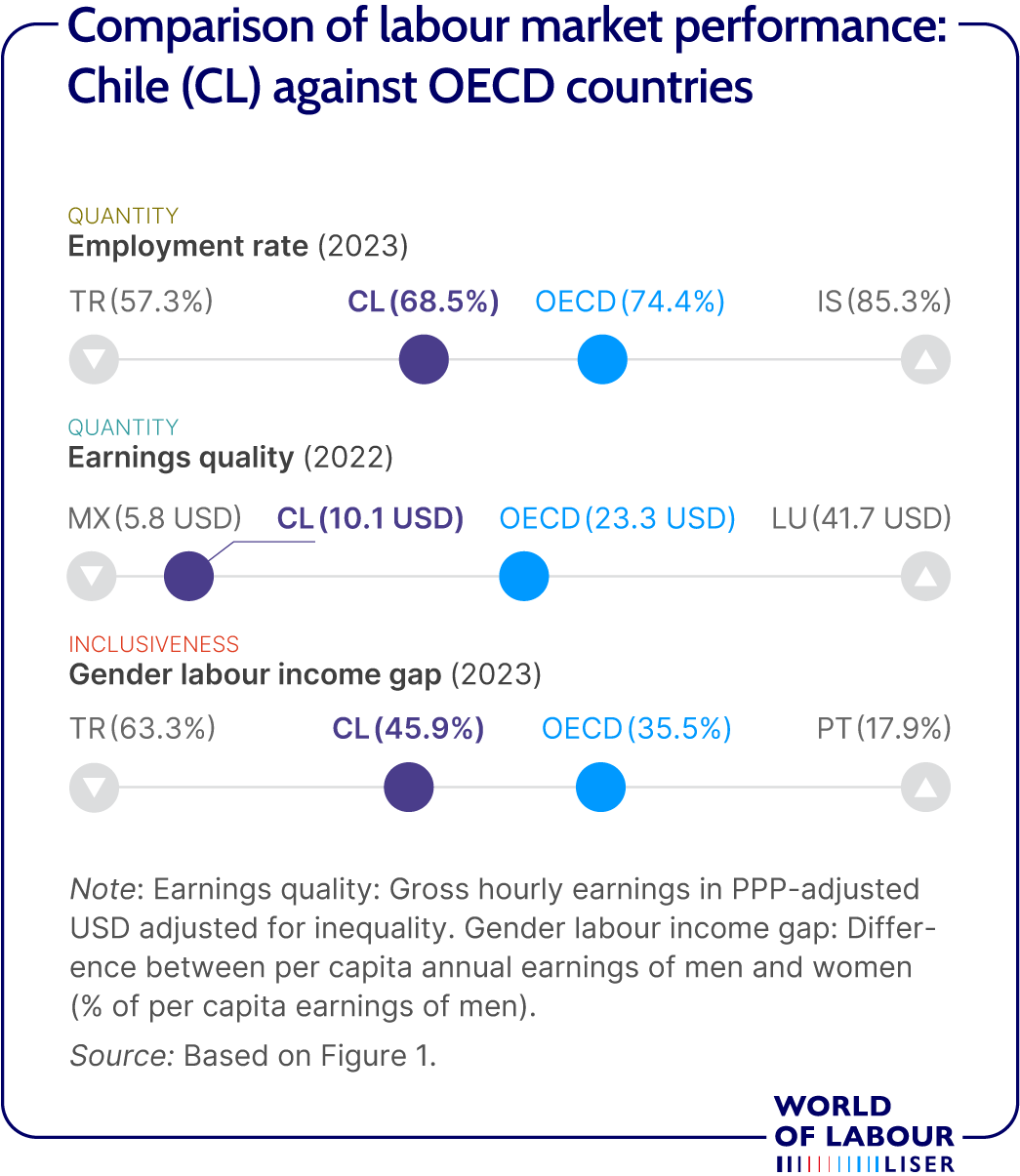
In the past 25 years, the Chilean labour market has observed a modernisation in terms of its transition to a service economy, but also in terms of its institutional robustness. It has seen a consistent growth in the labour force, driven by women’s entrance in the labour market, and a sustained increase in earnings from salaried work. However, it faces obstacles to drive growth through labour productivity and to ensure that growth translates to better socioeconomic outcomes for workers as a large low-productivity segment persists, also driving informality. These obstacles include lengthy permits, human capital deficits, low R&D investment, as well as slow technological adoption. Solving these issues requires coherent policy making beyond employment and labour policy.
Key findings
Strengths
Chile has seen an increase in labour force participation, driven mostly by women entering the labour market.
There was a sustained increase in real wages in the past 20 years.
Inequality in labour-income has decreased substantially in Chile.
Labour market institutions have been strengthened since 2000.
Weaknesses
Lengthy permits, human capital deficits, low R&D investment, and slow technological adoption are some of the structural obstacles hindering labour productivity.
High levels of informality persist in specific sectors and for specific workers, limiting access to labour protection and social security.
Gender, regional, and income inequality still persist.
There is limited fiscal space for strengthening labour market institutions and for adopting active labour market policies.


