
Elevator pitch
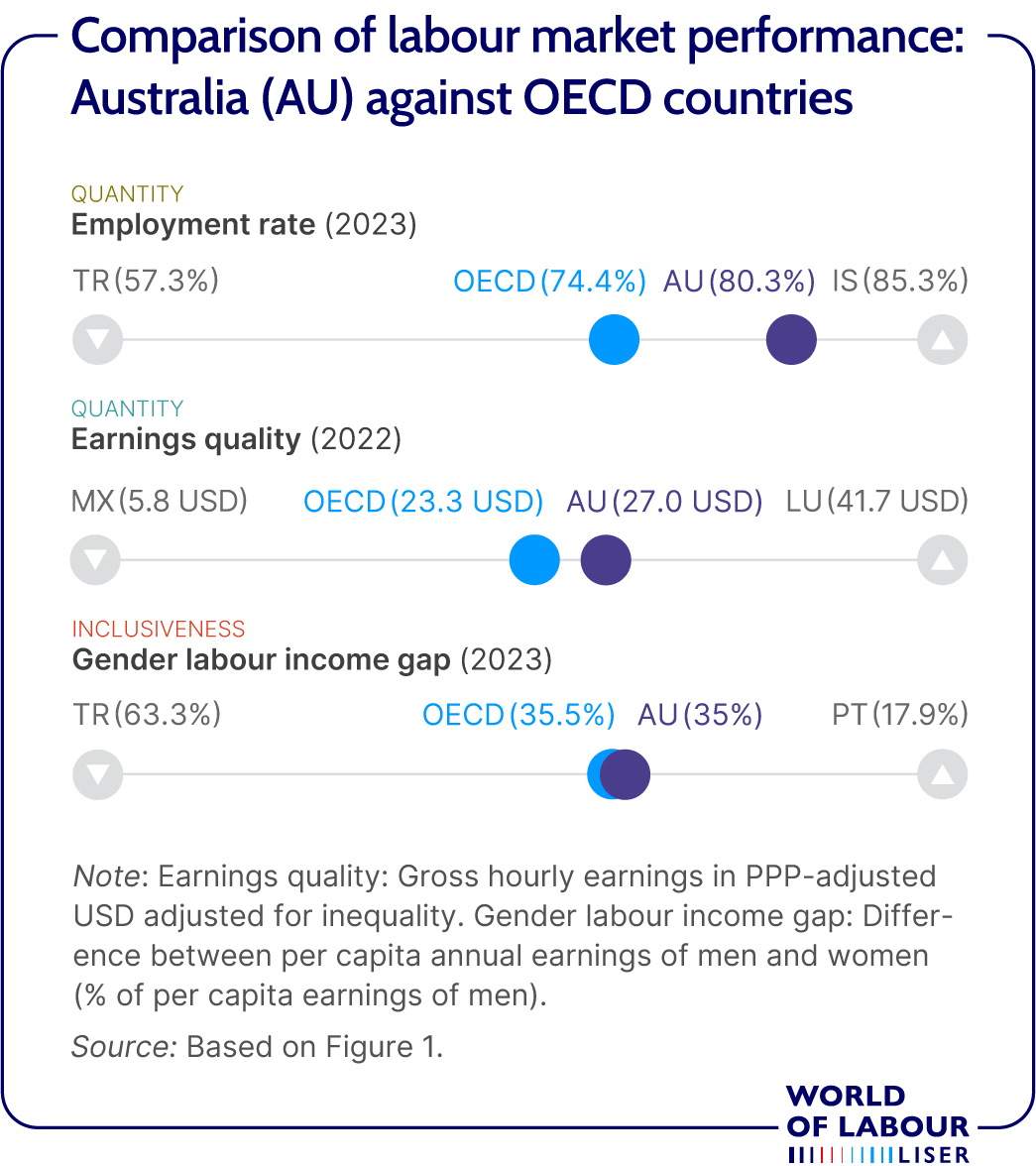
Since 1991 the Australian economy has experienced sustained growth. Aided by the commodities boom and strong public finances, the Australian economy negotiated the global financial crisis without falling into recession. However, the dislocation associated with the Covid-19 pandemic saw the economy enter recession in 2020, before sharply rebounding. Since 2022, unemployment and real weekly earnings have returned to pre-Covid-19 levels but more recently real wages have slipped due to high inflation. Further recent headwinds include a rise in long-term unemployment, deteriorating youth labour market, and a stagnant gender earnings gap.
Key findings
Strengths
Australia experienced three decades of sustained economic growth from 1990, leading to strong growth in employment and lower unemployment rates.
The economic dislocation associated with the Covid-19 pandemic resulted in a brief recession in 2020, followed by a quick rebound; unemployment fell to multi-decade lows in 2022–23 before easing slightly.
Labour force participation of men and women aged 55–64 years has increased and grew most rapidly for those aged 65 and over.
Real average earnings of full-time workers have increased.
Following rising income inequality from the late 1970s to 1990, inequality has remained relatively stable since 2000.
Weaknesses
Despite sustained economic growth, long-term unemployment has increased over the past decade, returning to the relatively high levels of the early 2000s.
Gains in earnings through the 2000s–2010s were partly reversed post-Covid, with a record real wage fall in 2022 and only partial recovery more recently.
Teenage workers face limited labour market opportunities.
There has been remarkably little improvement in the gender earnings differential since 2000.


