Relevanz des Themas
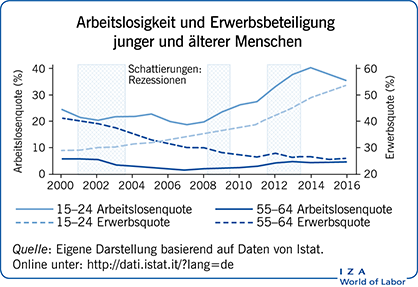
Der italienische Arbeitsmarkt hat eine massive Double-Dip-Rezession durchlaufen, von der er sich seit 2014 allmählich erholt. Die Arbeitslosigkeit sinkt nur langsam und liegt insbesondere unter Jugendlichen noch deutlich über dem Vorkrisenniveau. Zugleich hat die Frauenerwerbsquote geringfügig zugenommen. Die regionalen Unterschiede sind nach wie vor groß: Der stagnierende Süden hält mit dem Norden nicht Schritt. Zwar steigen die Realeinkommen, doch die Produktivität verharrt im europäischen Vergleich auf niedrigem Niveau. Schwarzarbeit ist vor allem im Süden verbreitet.
Wichtige Resultate
Pro
Nach einem deutlichen Anstieg während der doppelten Rezession gehen Gesamt- und Langzeitarbeitslosigkeit seit 2014 wieder zurück.
Die Zahl der offenen Stellen ist seit dem massiven Einbruch im Jahr 2009 wieder gestiegen.
Die Frauenerwerbstätigkeit nimmt zu, wenn auch langsam.
Die Erwerbsbeteiligung älterer Arbeitnehmer (55-64 Jahre) hat in den letzten Jahren erheblich zugenommen.
Die Realeinkommen sind gestiegen, ohne jedoch mit entsprechendem Produktivitätswachstum einherzugehen.
Contra
Die Arbeitslosigkeit liegt noch immer über dem Vorkrisenniveau.
Der Süden hinkt dem Norden des Landes bei allen Arbeitsmarktindikatoren hinterher; Konvergenz ist nicht in Sicht.
Die Frauenerwerbsquote bleibt vor allem im Süden niedrig.
Die Jugendarbeitslosigkeit ist nach der Krise erheblich gestiegen und nimmt erst seit 2014 wieder langsam ab.
Die Erwerbsbeteiligung Jugendlicher (15-24 Jahre) ist seit 2000 deutlich zurückgegangen.
