
Elevator pitch
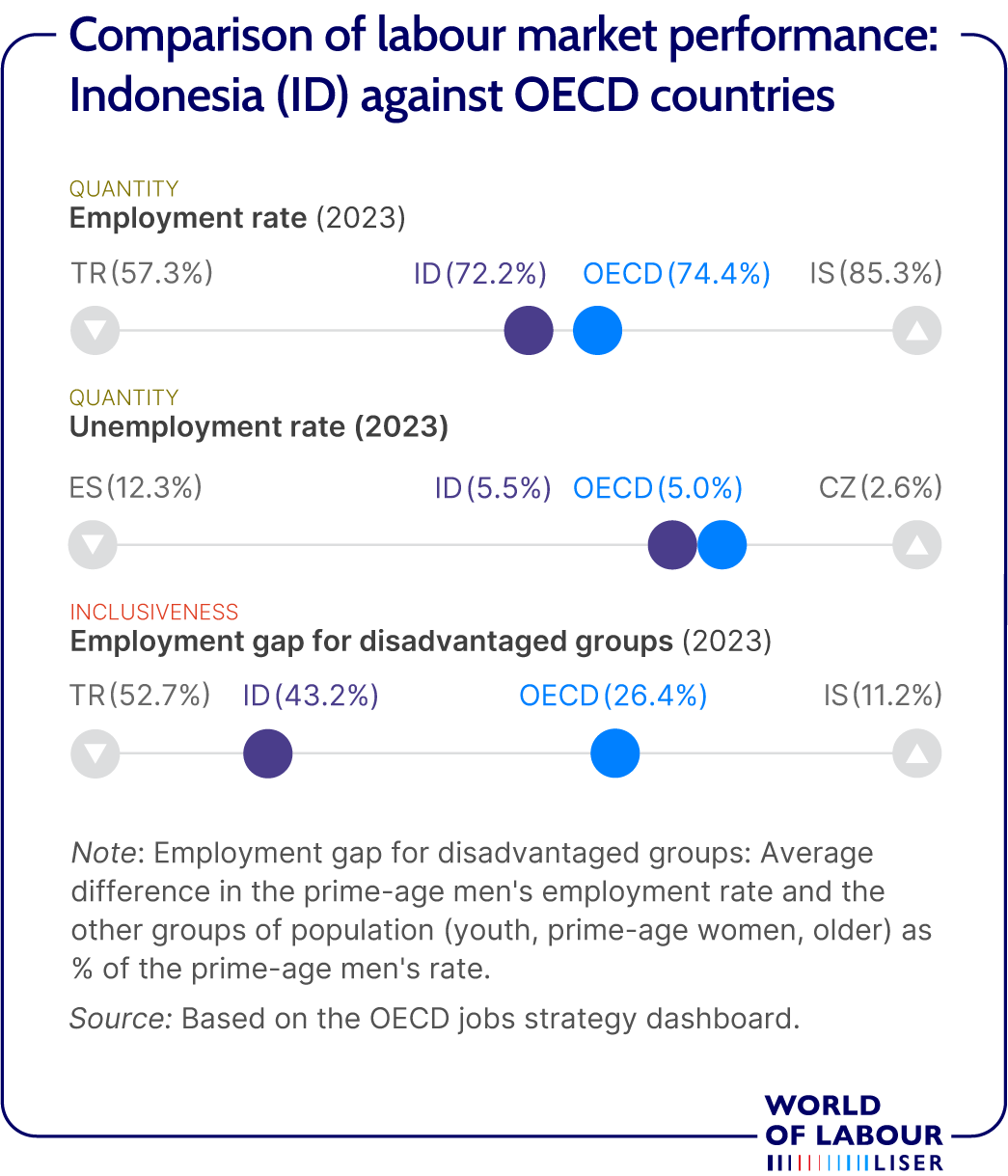
Indonesia’s labour market absorbed over 50 million additional workers between 2001 and 2024, while unemployment fell from 8% to under 5%. Yet job quality has not kept pace. Structural transformation, the movement of workers out of agriculture, has largely bypassed manufacturing and channeled labour into low-value-added services; 58% of workers remain informal; median earnings stand roughly 40% below the average minimum wage, even though more than a quarter of the workforce works over 48 hours per week; and female labour force participation trails male participation by 28 percentage points. These four interconnected features define Indonesia’s labour market challenge.
Key findings
Strengths
The labour market has absorbed a large number of new workers, contributing to lower unemployment.
A growing working-age population has supported productivity gains across the economy.
The labour market has shown resilience, recovering quickly after the Covid-19 contraction.
Economic growth has outpaced employment absorption, signaling rising aggregate labour productivity, although these gains have not yet translated into broad-based wage growth.
Weaknesses
Informality remains widespread, with a much higher share of workers outside formal employment.
Many workers are trapped in low pay and long working hours, with real wages lagging behind minimum standards.
Female labour force participation continues to trail that of men by a wide margin, and female employment is concentrated in informal, home-based, and unpaid family work.
Structural transformation is incomplete, with labour shifting from agriculture into low-value-added services.
A persistent gender wage gap exists.


