
Elevator pitch
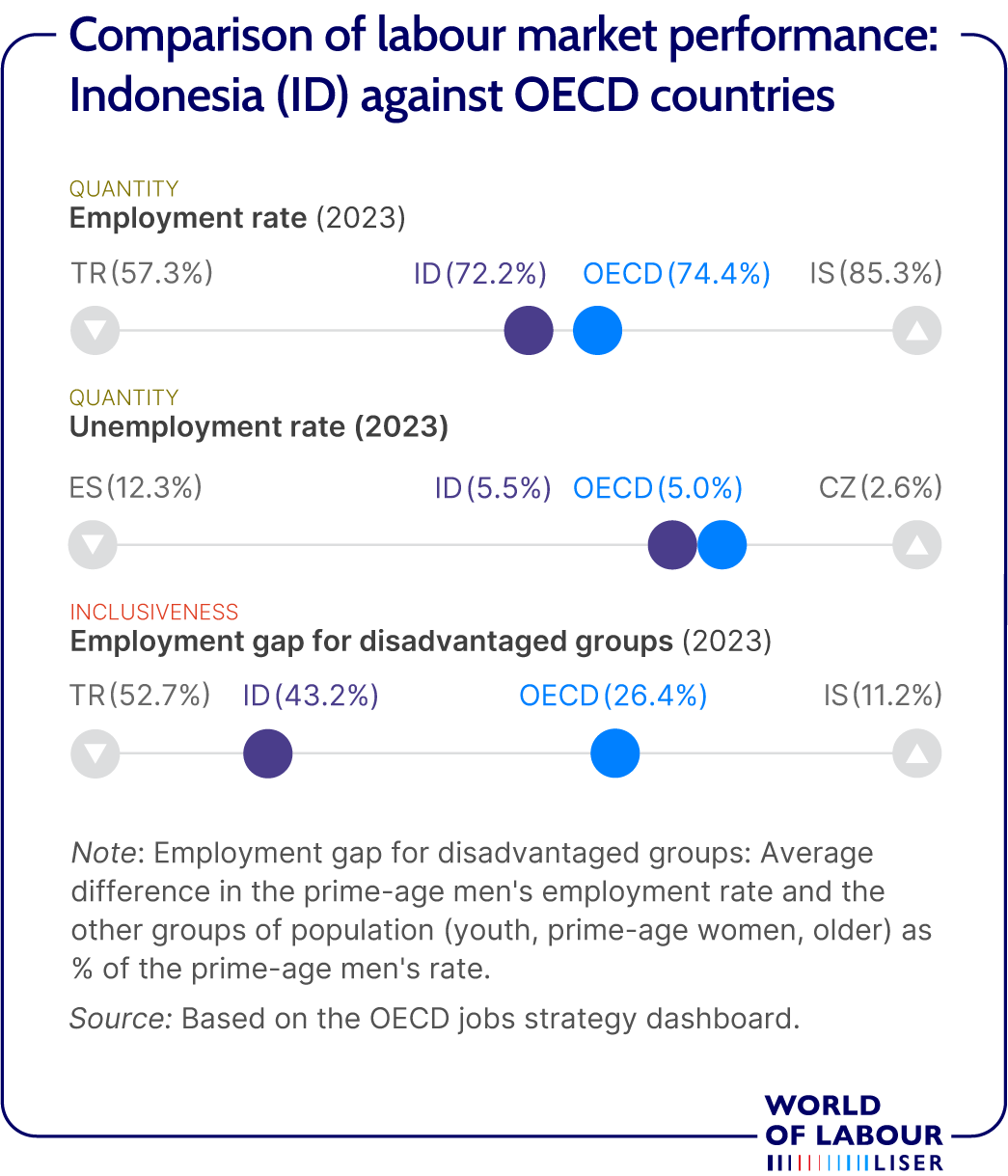
Indonesia’s labour market absorbed over 50 million additional workers between 2001 and 2024, while unemployment fell from 8% to under 5%. Yet job quality has not kept pace. Structural transformation, the movement of workers out of agriculture, has largely bypassed manufacturing and channeled labour into low-value-added services; 58% of workers remain informal; median earnings stand roughly 40% below the average minimum wage, even though more than a quarter of the workforce works over 48 hours per week; and female labour force participation trails male participation by 28 percentage points. These four interconnected features define Indonesia’s labour market challenge.
Key findings
Strengths
The labour market has absorbed a large number of new workers, contributing to lower unemployment.
A growing working-age population has supported productivity gains across the economy.
The labour market has shown resilience, recovering quickly after the Covid-19 contraction.
Economic growth has outpaced employment absorption, signaling rising aggregate labour productivity, although these gains have not yet translated into broad-based wage growth.
Weaknesses
Informality remains widespread, with a much higher share of workers outside formal employment.
Many workers are trapped in low pay and long working hours, with real wages lagging behind minimum standards.
Female labour force participation continues to trail that of men by a wide margin, and female employment is concentrated in informal, home-based, and unpaid family work.
Structural transformation is incomplete, with labour shifting from agriculture into low-value-added services.
A persistent gender wage gap exists.
Author's main message
Indonesia has been remarkably effective at creating jobs and absorbing a rapidly growing labour force. Unemployment is low and falling. Job quality, however, has not followed: workers leaving agriculture have moved into wholesale and retail trades rather than manufacturing, most employment remains informal, wages are low relative to hours worked, and women face structural barriers to participating on equal terms with men. These four features reinforce one another: the sectors absorbing former farm workers are those in which informality is highest, informality depresses wages, low pay pushes workers into longer hours and multiple jobs, and the absence of care infrastructure keeps women in unpaid or home-based work. Policy must address all four simultaneously: steering structural change toward higher-productivity activities, lowering the compliance costs that deter formalization among small firms, raising wages through productivity rather than through longer hours, and investing in care services that allow women to enter and remain in the labour force.
Motivation
Indonesia is the world’s fourth most populous country, with a working-age population exceeding 200 million. Its economy grew at an average rate of 5% per year between 2001 and 2024, with steady average employment growth of around 1–2% each year. Unemployment, which peaked at 11.2% in 2005 following the aftershocks of the Asian financial crisis, declined to 4.9% by 2024 (Figure1(a)). In addition, the unemployment rate shows a consistent downward trend across gender and education categories from 2001 to 2024, pointing to a broad-based improvement in labour market outcomes. Unemployment among workers with secondary education, initially the highest at around 16% in 2005, declined steadily to about 6% by 2024, while the rate among tertiary-educated workers followed a similar trajectory. Gender differences narrowed over time, with women’s and men's rates starting at roughly 10% and 7%, respectively, and converging to about 5% by 2024. Unemployment among workers with primary education remained the lowest throughout, falling from around 6% to 3% (Figure 1(b)). The concentration of unemployment among secondary- and tertiary-educated workers, rather than among those with only primary schooling, is a well-documented feature of developing-country labour markets rather than an Indonesian anomaly: relatively educated jobseekers, typically from better-off households, can afford longer job search and queue for scarce formal-sector vacancies, holding reservation wages above what informal work pays, whereas the least educated cannot afford to remain unemployed at all.
 Despite two decades of sustained economic growth and falling unemployment, the quality of employment has not improved at the same pace. Manufacturing’s share of employment barely moved: 13.3% in 2001, 13.8% in 2024 (Figure 1(c)). The 15 percentage points of workers that left the agriculture sector went almost entirely into low-value-added services such as trade, food and beverage, and accommodation. Furthermore, Indonesia’s informal employment share, at 58% under the status-based measure used in national statistics and 76% under the updated ICLS-17 standard (International Conference of Labour Statistics), exceeds the rates in peer middle-income economies such as Brazil (40%) and Turkey (30%). Real wages have grown slowly and unevenly, with median real monthly earnings among all workers barely exceeding Rp 2 million by 2024, or nearly 40% below the average national minimum wage of Rp 3.2 million. Workers compensate by working long hours: more than one in four works over 48 hours per week, and the share of workers holding multiple jobs reached nearly one-fifth (18%) in 2018 before settling at 13% in 2024.
Four structural features of the Indonesian labour market shape this puzzle. First, the movement of workers out of agriculture has largely bypassed the industrialization process, taking workers directly into low-value-added services. Second, female labour force participation, though rising, remains 28 percentage points below male participation, with women disproportionately channeled into informal, home-based, and unpaid family work. Third, informality remains pervasive, concentrating workers in low-value-added jobs and limiting their access to social protection. Fourth, low wages coexist with long working hours, creating an equilibrium in which workers substitute effort for adequate compensation. These four dimensions are interdependent: they reinforce each other, and they define the central challenge facing Indonesian labour market policy.
This article examines each dimension in turn, drawing on data from the National Labor Force Survey (SAKERNAS, Survei Angkatan Kerja Nasional) from 2001 to 2024. It documents the macro performance of the labour market before turning to the four core issues: structural labour transformation, female labour force participation, job informality, and the low-pay-long-hours trap. The article then concludes with policy implications.
Discussion of strengths and weaknesses
Labour market performance
Indonesia’s working-age population grew from roughly 140 million in 2001 to over 210 million in 2024. Total employment expanded from 91 million to 145 million over the same period, an increase of nearly 60%. Figure 1 shows that the labour force participation rate (LFPR) stood at 69% in 2001, drifted down to a trough in 2015, and then rose steadily to 71% by 2024. The recovery has been driven primarily by rising participation among women, less educated workers, and older workers (Figure 2). Meanwhile, unemployment fell almost continuously from its 2005 peak of 11.2% to 4.9% in 2024. The 2020 pandemic pushed the rate temporarily to 7.1%, but recovery was swift: by 2022, the rate had returned to pre-pandemic levels.
 Beyond this employment growth, Indonesia has seen an incomplete structural transformation of employment. Agriculture’s share of employment fell from 44% in 2001 to 28% in 2024 (Figure 1(c)). The workers leaving agriculture were absorbed primarily by trade and services, which grew from 20% to 27% of employment, and by accommodation and food services, which nearly doubled its employment share. Manufacturing’s share, however, has been largely flat, hovering around 13% throughout the period. Indonesia’s structural transformation has been predominantly a direct shift from agriculture to low-value-added services rather than into manufacturing, a picture consistent with premature deindustrialization and a pattern that distinguishes it from the earlier East Asian industrializers [1], [2].
Manufacturing jobs sit in the middle of Indonesia’s sectoral wage ladder: median pay in manufacturing is higher than in the low-wage services that have absorbed most of the new employment, such as trade, accommodation and food services, and other services, though it remains below high-wage sectors such as finance, information and communication, and public administration [3]. Manufacturing firms are also, on average, larger than service-sector establishments, more likely to be registered with tax and local authorities, and more likely to remit national employment insurance contributions on behalf of their workers [4].
The distinction between output and employment sharpens this diagnosis of premature deindustrialization: manufacturing’s share of GDP peaked and began declining at an income level far below that of the earlier industrialisers [1], while its employment share merely stagnated, itself a signal of weak productivity growth within the sector. Indonesia’s version of the pattern also has a distinctly resource-based origin. The commodity boom of 2003–11, led by palm oil and coal, appreciated the real exchange rate and squeezed the competitiveness of tradable manufacturing, while the booming resource sectors created few formal jobs of their own. District-level evidence shows that exposure to the palm oil boom predicts lower formal employment and, through that channel, lower earnings [5]. The boom, therefore, helps reconcile a puzzle that runs through this article: aggregate productivity and income rose, but a large share of the gains accrued to resource rents and capital rather than to labour, while employment growth concentrated in low-productivity, informal services.
Gender gaps in the labour market
Figure 2(a) shows female participation rising from 51.8% in 2001 to 56.4% in 2024, following a U-shaped path that bottomed out at 49% around 2006–07 and turned upward after 2015. Male participation, by contrast, remained consistently high, fluctuating between 82% and 85% throughout the period. The rise in participation since 2015 is linked to the decline in the share of working-age women reporting “housekeeping” as their main activity, after it had barely moved in the mid-2000s. The female youth NEET rate (that is women aged 15–24 not in employment, education, or training) fell from about 40% in 2001 to 24.1% in 2024, narrowing the gap with the men’s rate. These rates are well below those of India, Bangladesh, and Pakistan, which remain above 40%. Despite this continued improvement, female participation in Indonesia remains below that of Vietnam (near 70%) and Thailand [6].
Although women’s participation has improved since 2015, the nature of female employment differs substantially from that of men. Women are overrepresented in unpaid family work, informal employment, and home-based entrepreneurial work in low-margin sectors such as trade, food, and personal services [4]. Figure 2(b) shows that the share of female workers in informal employment is roughly 8 percentage points higher than that of men, and the gap has widened in recent years. By working status, one in four working women is an unpaid family worker (Figure 2(c)). The gender wage gap compounds the job-status gap. Figure 3 illustrates that, at the median, women earned 39% less than men, with only 38% earning above the applicable minimum wage in 2024. The pay gap has also widened since 2010, meaning that women’s median earnings have fallen progressively further behind men’s.
 The mechanism behind this widening pattern, which is not directly identifiable in Figure 2 and Figure 3 is likely a “motherhood penalty” that operates through a shift into informal work. The direct evidence for this channel comes from other developing regions, notably Latin America, where the arrival of children pushes mothers out of formal wage employment and into informal self-employment [7]; for Indonesia it should be read as an inference from that broader evidence combined with the descriptive patterns above, rather than as a mechanism demonstrated in these data. The Indonesia-specific evidence that does exist points the same way: the gap concentrates among mothers who have moved out of wage employment into informal self-employment or home-based micro-enterprise, rather than reflecting a uniform pay cut across all women [4], and greater availability of public preschools significantly raises mothers’ employment, indicating that childcare constraints bind [8]. The ILO estimates that women’s unpaid domestic and care work averages roughly 4 hours per day globally, compared with about 1 hour for men. Closing the pay gap, therefore, requires redistributing care time and reducing the care-cost wedge on formal-sector employment, not only by increasing women’s labour force participation.
Figure 3 presents real monthly wages, adjusted to the 2022 provincial Consumer Price index (CPI) base, and highlights a persistent disparity between male and female workers in Indonesia’s labour market. Although wages have gradually increased over time, male workers consistently earn more than female workers at the median level. This difference is not simply a matter of pay but reflects structural inequalities in employment opportunities and job allocation. Male workers are more likely to be employed in formal sectors with higher productivity and stronger social protection, while women are disproportionately concentrated in informal, home-based, or unpaid family work. These patterns reinforce wage inequality and limit women’s access to stable and well-compensated employment. The burden of unpaid domestic and care work, which falls more heavily on female workers, further restricts their ability to participate fully in formal, full-time jobs, pushing them into lower-paying and more vulnerable positions.
The wage gap therefore illustrates that gender inequality in Indonesia’s labour market is shaped by sectoral segregation, differences in employment status, and unequal care responsibilities. Addressing this issue requires more than enforcing equal pay: it demands structural reforms that expand women’s access to formal employment, provide opportunities for skills development in higher-value sectors, and invest in care infrastructure to reduce the time cost barrier that limits women’s participation. In short, the real wage analysis shows that the gender pay gap reflects broader systemic challenges. Tackling these barriers through integrated labour, social, and gender-sensitive policies is essential to ensure that female workers can contribute more fully to economic growth and benefit equally from Indonesia’s labour market progress.
Informality, wages, and working hours
Informality is the defining feature of Indonesian employment. In 2024, about 58% of workers were informal under the status-based measure used in national statistics, and the share was roughly 76% under the updated ICLS-17 standard. The two figures answer different questions. The lower one classifies workers by employment status, counting own-account workers, casual workers, and unpaid family workers as informal. The ICLS-17 measure instead asks whether the job itself is covered by labour legislation and social protection, so an employee of a registered firm who receives no social security contributions also counts as informal. Only the status-based series runs consistently back to 2001, so the trends reported here use that definition; the two numbers are alternative levels rather than points on a single series. Figure 4 shows how unevenly informality is distributed across the 17 main sectors. It is near-universal in agriculture and very high in construction, trade, and accommodation and food services, the same low-value-added activities that absorbed workers leaving farming, while it is lowest in capital-intensive or public-facing sectors such as mining, utilities, finance, and public administration.
 The pattern confirms that the post-agricultural transition has channeled most workers into precisely the sectors in which written contracts, job protection, and social-insurance coverage are weakest. This sorting carries a wage penalty. Figure 5 compares the median earnings of formal and informal workers and shows a formal-sector premium of about 86%. This is a raw differential, not an estimate of the causal return to formality: formal workers are more educated and more urban, and formal jobs concentrate in larger, more capital-intensive firms and better-paid occupations, so much of the premium reflects worker selection and composition. Indonesian evidence that adjusts for worker characteristics finds a smaller, though still positive, premium and substantial heterogeneity within the informal sector [9]. Part of the premium is also institutional, since formal wages are anchored by minimum wage floors and social insurance mandates that do not bind in the informal segment. Informality is therefore not only a contractual status but a marker of low pay and limited protection.
 A useful lens on this informality is home-based work: self-employment, household enterprises, and domestic work carried out in or from the home. Of the roughly 18 million jobs Indonesia added between 2018 and 2024, about three-quarters were home-based, while formal corporate employment grew only marginally [10]. These jobs are informal almost by definition: only about 2% of home-based workers hold a formal arrangement; just 4% have a written contract, and two-thirds are paid daily or weekly. Social protection is correspondingly thin: around 2.5% have health insurance and under 1% have pension or unemployment coverage, compared with roughly 75% health coverage for government and corporate employees. The burden is also heavily gendered: women are about four times more likely than men to be unpaid family workers, and married women in particular are channeled into unpaid home-based roles by family obligation rather than economic opportunity.
The formal–informal wage gap also explains one of the most striking findings: the median Indonesian worker earns just under Rp 2 million per month, roughly 40% below the average statutory minimum wage of Rp 3.2 million. The comparison is not a paradox but an accounting identity of a majority-informal labour market: with 58% of workers outside the regulated segment, the statutory floor binds, at best, for the formal minority, while the economy-wide median is set in the uncovered segment. The median-below-minimum finding is thus the single clearest indicator of the limited reach of Indonesia’s labour market institutions, and it frames the discussion of wages and hours that follows.
The minimum wage itself, therefore, warrants treatment as an institution rather than a mere benchmark. Indonesia sets minimum wages at the provincial level (UMP), and most districts and cities adopt higher local floors (UMK) on the recommendation of tripartite wage councils, generating wide regional variation: floors in the Jakarta–Karawang industrial belt are more than double those in poorer provinces. The adjustment rule has changed repeatedly: from decentralized and often politically driven increases in the 2000s, to a fixed inflation-plus-growth formula in 2015, to new formulas issued under the Job Creation Law framework in 2021 and 2023. Evidence for Indonesia is mixed: minimum wage increases have raised average wages and, in some settings, formal employment [11], while other studies find negative effects on formal employment and spillovers of workers into the uncovered informal segment [12]. Enforcement is thin, even among covered employees; a substantial share is paid below the applicable floor, so the system’s practical coverage is far narrower than its statutory ambition.
The most consequential labour market reform of the period under review is the Job Creation Law (Law 11/2020, the ‘Omnibus Law’, re-enacted as Law 6/2023 following a constitutional challenge). Its labour cluster reduced statutory severance entitlements while introducing an unemployment insurance scheme (JKP), relaxed restrictions on fixed-term contracts and outsourcing, and recentralised and reformulated minimum wage setting. The reform’s explicit rationale, that high firing and compliance costs deter formal job creation, corresponds directly to the formalisation agenda discussed in this article. Rigorous evaluations of its labour market effects are not yet available: the law took effect amid the pandemic recovery, and its implementing regulations have been revised repeatedly. What aggregate data show so far is that formalisation has not visibly accelerated: informality still stood at 58% in 2024. The law’s medium-run effect on formal job creation is therefore the most important open empirical question for Indonesian labour market policy.
Figure 6 cross-tabulates weekly hours against monthly wages. Workers are concentrated in the bottom-right of the grid: the densest cells, each holding more than 3% of the workforce, fall among those working over 50 hours a week and earning between Rp 1 million and Rp 3 million a month. The largest group of workers, therefore, reaches only near-minimum pay despite long hours. Density thins rapidly above Rp 5 million and is negligible in the Rp 5.5–10 million range across all hours. Longer hours are thus associated with a low pay ceiling rather than with access to higher-paid formal jobs.
 Two episodes disrupted working hours: the domestic slowdown of 2013–15, which followed the “taper tantrum” capital-flow reversal and the end of the commodity price boom, and the Covid-19 pandemic in 2020–21. During the pandemic, the share of workers putting in fewer than 35 hours a week rose to about 37%, the highest level in the series, while average hours fell to their lowest, reflecting a shift toward involuntary part-time and informal work (Figure 7).
 Beneath these fluctuations lies a stable gender divide. Average weekly hours for men exceeded those for women by roughly 5–6 hours across the entire period, including during crises. This parallel tracking reflects the structure documented earlier: men are concentrated in formal jobs with fixed schedules, while women more often combine informal commerce, unpaid home-based work, and caregiving responsibilities.
By 2022–24, hours had returned to their pre-pandemic norms: the average settled at about 40.5 hours a week and the share working under 35 hours fell back to roughly 32%. The speed of this reversion suggests that hours adjust flexibly to shocks, after which the labour market returns to its longstanding, gender-segmented pattern.
Limitations and gaps
Three limitations should be noted. First, the National Labor Force Survey is a repeated cross-section rather than an individual panel, so the analysis describes associations across cohorts rather than changes within the same workers; the claims about the motherhood penalty and transitions into informality are therefore associational, not causal. Second, the survey contains no time-use data on household and care work, so the care-burden mechanism is inferred from ILO aggregates rather than measured directly in the sample. Third, gig and platform work is not separately identified in the survey’s status categories and is likely folded into informal self-employment, which probably understates the newest forms of informal work.
These gaps point to clear priorities for future data collection: a rotating individual panel, a time-use module, and explicit measurement of platform employment.
Summary and policy advice
Indonesia’s labour market has achieved significant progress in expanding employment opportunities and reducing unemployment, yet the overall quality of jobs remains a major challenge. Most workers are still concentrated in informal sectors with low productivity, limited social protection, and wages that do not reflect the effort involved. Many compensate for inadequate pay by working excessively long hours or holding multiple jobs. At the same time, women’s participation in the labour force, although improving, continues to lag behind men’s and behind regional peers. Women are disproportionately engaged in unpaid family and domestic work, home-based activities, and informal self-employment, which reinforces both wage inequality and vulnerability.
These four features—an incomplete shift out of agriculture, pervasive informality, low pay alongside long hours, and gender inequality—are not isolated but deeply interconnected. Informality suppresses wages and benefits, which drives workers to extend their working hours. The lack of care infrastructure further restricts women’s ability to participate fully in the labour market, pushing them into precarious forms of employment. This cycle undermines both productivity and inclusiveness, limiting the potential of Indonesia’s labour force. Policy responses must therefore be comprehensive and simultaneous. Strengthening formalization incentives is crucial, particularly by reducing compliance burdens for small enterprises and ensuring broader access to social protection. Promoting productivity-driven wage growth through investment in skills, technology, and higher-value industries will help raise incomes without requiring longer hours. Expanding care infrastructure, such as affordable childcare, eldercare, and family-friendly workplace policies, will enable more women to enter and remain in formal employment, reducing the gender gap and unlocking untapped labour potential. Several of these priorities (lower compliance costs for formal hiring, easier formalisation) are stated objectives of the Job Creation Law; the immediate task is therefore rigorous implementation and evaluation of that reform rather than new legislation.
Acknowledgments
The authors thank the anonymous referee(s) and the World of Labour editors for their many helpful suggestions on earlier drafts of this article. This article was produced with support from the Hibah Pengabdian Masyarakat program of the Fakultas Ekonomika dan Bisnis, Universitas Gadjah Mada (FEB UGM), Yogyakarta, Indonesia (Grant No. 2262/UN1/EK/RDSI/PM.01.03/2026), which provided funding and access to data. The authors also gratefully acknowledge the excellent research assistance of Dionisius Maleaki Pinilih and Vika Septi Rahmawati.
Competing interests
The World of Labour project is committed to the European Code of Conduct in Research Integrity. The authors declare to have observed the principles outlined in the code.
© W. S. Nugroho, E. Sulistyaningrum, K. R. Hidayat


