
Elevator pitch
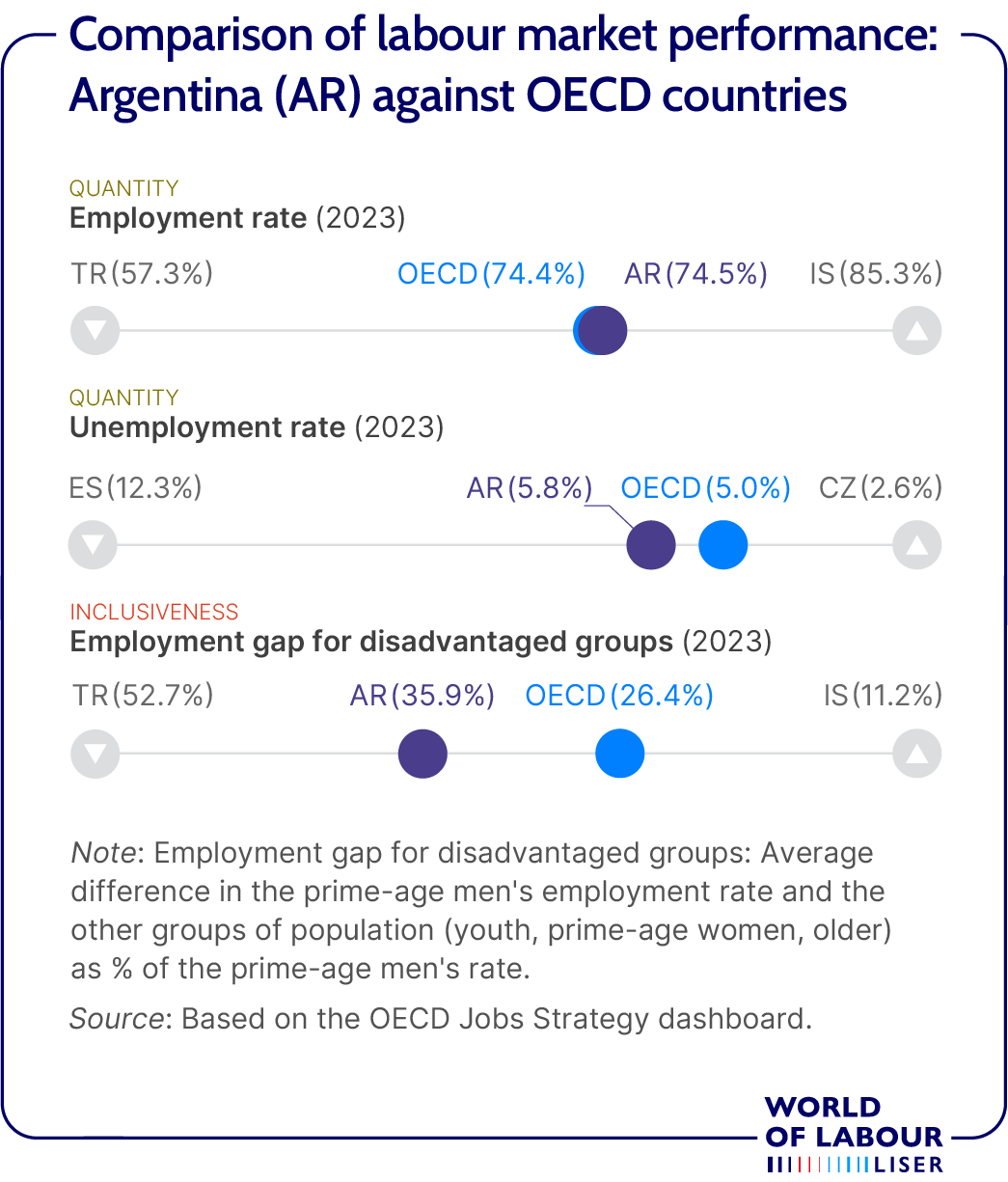
Argentina’s labour market experienced two sharply contrasting periods. The first, between 2003 and 2012, was characterized by falling unemployment, rising real wages, declining inequality, and improvements in formal employment. The second was marked by prolonged macroeconomic instability, stagnant productivity, and deteriorating labour market conditions. Despite relatively low unemployment rates, real wages collapsed, informality remained persistently high, and a growing share of workers became poor despite being employed. At the same time, human capital accumulation among younger cohorts has weakened significantly. Argentina's labour market challenge is no longer primarily one of unemployment but of job quality.
Key findings
Strenghts
Female labour force participation increased substantially, reducing gender gaps in employment.
Unemployment declined significantly relative to the crisis levels of the early 2000s.
Employment rates remain relatively high despite repeated macroeconomic crises.
Labour-income inequality declined substantially during the 2000s.
Weaknesses
Recurrent macroeconomic instability has significantly deteriorated labour market conditions since 2012.
Real wages have declined sharply, particularly since 2018.
Job quality remains poor, with persistently high levels of informality and underemployment.
Human capital accumulation among younger cohorts is deteriorating at an alarming rate.
Argentina has struggled to create formal private-sector jobs over the last decade.
Author's main message
Argentina’s labour market no longer suffers primarily from high unemployment, but from persistently poor job quality, declining real wages, high informality, and deteriorating human capital accumulation. Restoring macroeconomic stability is necessary but not sufficient: sustainable improvements in living standards will also require policies that foster formal private-sector job creation, improve educational quality, and raise productivity growth and wages.
Motivation
The 2003–25 period transformed Argentina’s labour market through two sharply contrasting phases. Following the 2001–02 crisis, favorable external conditions and a period of relative macroeconomic stability allowed unemployment to decline, real wages to recover, inequality to fall, and formal employment to expand. However, since the early 2010s, recurring macroeconomic instability, accelerating inflation, stagnant productivity, and repeated economic crises have progressively deteriorated labour market conditions. While unemployment remained relatively contained, real wages collapsed, informality remained persistently high, and a growing share of workers became poor despite being employed. At the same time, human capital accumulation among younger cohorts has weakened substantially, raising concerns about Argentina’s long-term growth potential. In a context of macroeconomic adjustment and structural reforms, future improvements in labour market conditions will depend not only on restoring macroeconomic stability, but also on increasing productivity, strengthening educational quality, and expanding the creation of formal private-sector jobs.
Discussion of strenghts and weaknesses
The challenging economic context of recurring crises
The labour market has been strongly influenced by Argentina’s macroeconomic trajectory since the early 2000s, characterized by recurrent cycles of recovery, expansion, and instability. Following the deep economic and financial crisis of 2001–02, the economy experienced rapid growth from 2003 to 2011, supported by a highly competitive real exchange rate, strong global demand for agricultural commodities, and a rebound in domestic consumption and investment [1]. This period combined favorable external conditions with policies that initially restored fiscal and external surpluses, contributing to macro-financial stability. However, beginning in the early 2010s, macroeconomic imbalances gradually intensified. Persistent fiscal deficits, growing reliance on monetary financing, and a gradual erosion of confidence in economic policy institutions, including the independence of the Central Bank and the autonomy of the national statistical agency, contributed to a prolonged period of economic stagnation alongside rising inflation. As a result, real GDP in 2023 was 1.25% lower than in 2012. During this period, average annual inflation reached 49.2%, and by 2023 it had risen to an extremely high level, exceeding 200% annually, raising concerns about a potential return to hyperinflation [2].
The policy shift following the election of a pro-market government in late 2023 marked the beginning of a new phase of macroeconomic adjustment aimed at restoring fiscal balance, stabilizing prices, and deregulating the economy. While these measures have begun to address key macroeconomic imbalances, Argentina continues to face significant structural challenges, particularly in its labour market, where high informality, low productivity growth, and weak job creation remain persistent constraints on sustainable development.
Increasing female labour participation, but not for the right reasons
Labour force participation in Argentina has followed different trajectories for men and women over the last 20 years (Figure 1(a)). While male labour force participation has remained stable at around 90%, female participation has experienced two distinct phases. Following a substantial increase during the 1990s–a widespread phenomenon across most Latin American countries–female participation stagnated at around 65% between 2003 and 2017. While the evidence on the causes of this stagnation remains inconclusive, some authors argue that strong regional economic growth may have reduced the need for vulnerable women to take low-quality jobs, reflecting improved labour market outcomes for their male partners and the expansion of conditional cash transfers targeting low-income households [3].
 In contrast, female labour supply has exhibited a sustained upward trend between 2018 and 2025, reaching levels close to 70% and leading to a substantial reduction in the gender gap. This pattern coincides with the recurring economic downturns Argentina has experienced in recent years. Recent studies document a countercyclical pattern in female labour supply: while vulnerable women may be less likely to enter the labour market during periods of economic expansion, they are more likely to do so when their household income or their partner’s employment is negatively affected, a mechanism known as the “added-worker effect” [4]. This pattern raises questions about whether these gains in female labour force participation can be sustained if the economy returns to a growth path. Moreover, the increase in female labour market participation has not been accompanied by comparable improvements in other dimensions of labour market outcomes. Estimates from standard Mincerian equations, a standard approach among economists to estimate the determinants and their effects on earnings, indicate that the conditional gender wage gap has remained relatively stable, fluctuating between 15% and 25%, with no clear long-term trend. This finding is consistent with the broader evidence for Latin America, which documents limited progress in closing the gap over the last 20 years and highlights that a substantial share of the gap remains unexplained by standard determinants of earnings such as education, age, region of residence, sector of activity, occupation, and formality status [5]. Taken together, these findings suggest that the recent reduction in participation gaps may not necessarily reflect broader improvements in women's labour market opportunities or relative earnings.
The unemployment rate does not reflect the state of the labour market
The Argentine labour market has been strongly shaped by the sequence of macroeconomic regimes observed between 2003 and 2025. Unemployment dynamics mirror these phases, particularly in the early years (Figure 1(b)). Following the 2001–02 crisis, unemployment rates exceeded 10%, reflecting the collapse in economic activity. During the subsequent recovery and expansion period (2003–08), unemployment declined steadily to around 7%. This downward trend continued, albeit at a slower and more volatile pace, between 2008 and 2012. However, as the economy entered a prolonged period of stagnation and macroeconomic instability after 2012, unemployment began to rise again, reaching levels close to 10% prior to the Covid-19 shock. It then declined temporarily during the post-pandemic recovery, before increasing again in recent years amid renewed macroeconomic adjustment. The evolution was similar for men and women, though women's unemployment rates remained consistently about 2 percentage points higher.
Despite these fluctuations, unemployment rates alone provide a misleading picture of labour market conditions during the 2012–23 period. This decade was characterized by falling or stagnant GDP and rapidly accelerating inflation, yet unemployment remained relatively contained. This apparent disconnect reflects the limitations of unemployment as an indicator of labour market health, particularly in developing economies such as Argentina. In environments characterized by macroeconomic instability and weak social insurance, unemployment is a poor indicator of labour market slack. Workers facing income constraints cannot remain unemployed for extended periods and instead transition into low-quality or informal jobs. This tendency has likely been reinforced by the emergence of digital platforms and new forms of independent work, which have expanded opportunities to generate income outside traditional employment relationships. Consequently, adverse labour market conditions are often absorbed through declines in job quality, increases in informality, or shifts toward more precarious forms of work rather than through increases in measured unemployment.
Consistent with this mechanism, alternative indicators reveal a much more pronounced deterioration in labour market outcomes, underscoring the importance of complementing unemployment rates with broader labour market indicators.
Real hourly wages and inequality first improved, then deteriorated following the economic cycle
Real hourly wages in Argentina display a clear cyclical pattern over the last two decades, closely aligned with the country’s macroeconomic trajectory. As shown in Figure 2(a), following the recovery from the 2001–02 crisis, wages increased steadily during the 2000s expansion, rising from around US$6.4 (in 2017 purchasing power parity, ppp) in 2003–04 to approximately US$8.8 (in 2017 ppp) by 2012–2013. This phase was followed by a period of stagnation, and, more markedly, by a sharp decline after 2018. By 2024, real hourly wages had fallen to about US$5.7 (in 2017 ppp), well below mid-2000s levels. Although there is evidence of a recovery in 2025 (to around US$7.7, in 2017 ppp), wage levels remain below their previous peak, suggesting limited long-term progress in earnings.
 This deterioration is also reflected in the purchasing power of labour income, as shown in Figure 2(b). At the peak of the previous expansion, around 2012, the median worker’s labour income was nearly 2.8 times the poverty line. By early 2024, this ratio had fallen to only 1.35, meaning that median labour earnings were much closer to the poverty threshold. The pattern is even more striking at the bottom of the distribution: the 25th percentile of labour income fell below the poverty line after 2019 and remained below it in 2024. As a result, the share of employed workers living in poor households increased substantially, and the share of full-time workers whose labour income was insufficient to escape poverty rose from around 7% in 2012 to more than 25% in early 2024. Although there was a recovery in 2025, labour income adequacy remained well below the levels reached in the early 2010s. It is worth noting that part of the sharp deterioration and subsequent recovery observed after 2024 in hourly earnings and other real income-based indicators may reflect measurement challenges associated with rapidly changing inflation. During periods of very high inflation, short-run movements in measured real wages should be interpreted with caution. Because wages typically adjust less frequently than prices, real wages tend to fall sharply when inflation accelerates and recover rapidly once inflation subsides, as nominal wages gradually catch up with past inflation. Moreover, translating these changes into workers' living standards becomes more difficult. Inflation affects households differently depending on their consumption baskets, nominal wages may change repeatedly over short periods, and prices, earnings, and consumption patterns become substantially more volatile. As a result, measured real wages become a noisier proxy for changes in purchasing power and economic well-being (see [6] for a related discussion in the context of poverty measurement).
Changes in wage inequality have followed a pattern that is partially similar but not identical [7]. Inequality in hourly labour income declined substantially during the 2000s, with the Gini coefficient (a common measure of inequality, with a value close to 1 referring to high inequality and a value close to 0 referring to perfect equality), falling from around 0.48 in 2003 to approximately 0.39 by the early 2010s. This downward trend ended in the following decade. After fluctuating between 0.39 and 0.41 from 2013 to 2018, inequality increased markedly in recent years, peaking at around 0.45 during the Covid-19 period (2020–21). Although it declined somewhat afterward, it remained elevated at about 0.44 in 2024–25, well above its historical minimum.
Taken together, these patterns point to a deterioration in labour market outcomes in recent years. While the 2000s were characterized by simultaneous improvements in both wage levels and their distribution, the post-2018 period has seen declining real wages alongside rising inequality.
Poor job quality remains a central issue
Argentina’s labour market combines relatively high employment and low unemployment rates with persistent weaknesses in job quality. A central feature is the resilience of informal employment. Figure 3(a) shows that productive informality among workers declined only modestly over the last two decades, from about 43% in 2003 to 41% in early 2025. Informality among salaried workers fell more sharply during the 2000s, from nearly 50% in 2003 to around 34% by 2012, but progress then stalled. By 2025, more than one-third of salaried workers still lacked formal employment status. This suggests that the employment gains observed after the early-2000s crisis were not accompanied by a sustained transition toward higher-quality, protected jobs.
 As discussed in the previous section, employment has become less effective as a shield against poverty. This is important in the Argentine context, where open unemployment is not the only (or even the main) indicator of labour market distress. Many workers remain employed, but in jobs that provide low and unstable earnings, limited social protection, or insufficient hours. In 2025, the official unemployment rate was below 8%, but when demand-side underemployment is added, labour underutilization reached about 18.5%. This broader measure shows that a sizeable share of the labour force either lacks a job or is employed but would like to work more hours or find another job. Multiple job holding provides an additional signal of labour market strain. Figure 3(b) shows that the share of workers with more than one job increased from about 9% in 2003 to around 11% in 2025, peaking at about 12% in 2024. This pattern is consistent with workers compensating for declining real labour income by taking on additional jobs.
Overall, Argentina’s labour market problem is not only about job creation but also about job quality. The country has reduced open unemployment relative to the early 2000s, but informality remains high, labour income has lost purchasing power, and a growing share of workers face poverty risks despite being employed. Improving job quality therefore requires policies that go beyond increasing employment rates: it also requires strengthening formal job creation, raising labour productivity, and ensuring that work provides sufficient income and protection.
Human capital remains high for Latin American standards, but younger generations are falling behind
Argentina’s human capital has continued to increase over time, but the pace of improvement has slowed markedly in recent years. The average years of education of the adult population increased from 10.4 in 2003 to 12.0 in 2021, and it has remained at that level through 2025 (Figure 4(a)). Moreover, most of the gains have been driven by the expansion of secondary education rather than improvements in tertiary attainment. In only a few decades, Argentina went from being one of the regional leaders in human capital accumulation to one of the weakest-performing countries in Latin America among younger cohorts.
 The situation is particularly concerning in terms of tertiary education. Only 24% of Argentina’s adult population has completed tertiary studies, compared to 42% across OECD countries, placing Argentina 38th out of 46 countries for which comparable data are available. While these figures remain above those of some Latin American peers, such as Brazil and Mexico, the most alarming aspect is the trajectory for younger generations. Recent cohorts are less likely to complete tertiary education than previous ones, suggesting that the gap may widen further in the future (Figure 4(b)). In particular, only 19% of Argentinians aged 25–34 have completed tertiary education, compared to 48% in the OECD. This figure is not only substantially below the OECD average, but also below that of other Latin American countries in the sample, including Brazil (24%), Mexico (29%), Colombia (37%), and Chile (41%). Argentina ranks 46th among 48 countries in this indicator among OECD countries [8]. At the same time, younger cohorts are also failing to accumulate human capital through labour-market experience: 24% of individuals aged 18–24 are neither studying nor working, compared with 14% across OECD countries.
This decline cannot be explained by a reduction in returns to education. In fact, returns to tertiary education in 2025 are around 50% relative to secondary education, almost the same as in 2005. The reason is primarily the deterioration of the educational system. Argentina’s university system is currently facing important challenges. Completion rates remain low: many students enroll, but relatively few graduate. Of every 100 students who begin university studies in Argentina, only 23 complete them, compared with 76 in Chile and 38 in Brazil. At the same time, public budgets have declined in recent years, creating additional constraints for the system. Yet the roots of the problem extend beyond universities themselves. Many students enter tertiary education without the foundational skills required to succeed, reflecting longstanding deficiencies in primary and secondary schooling.
Among other issues, the primary and secondary levels have become highly segregated by socio-economic status, with the upper and middle class migrating from public to private schools [9], while school calendars have shrunk due to extended holidays and interruptions to the school year [10]. Overall, since the 2000s, Argentina’s education policy has placed a much stronger emphasis on expanding access and inclusion in the school system, particularly at the secondary level, than on improving the quality of learning. As a result, the share of adults completing secondary education increased substantially (Figure 4, upper panel), but this expansion was accompanied by persistently low levels of student achievement and learning outcomes. This is reflected in international assessments such as PISA, where most students are low-performing (e.g., 73% in mathematics, compared to 31% in the OECD average) and quality has been deteriorating since 2012 [11].
Overall, the outlook for the evolution of human capital in Argentina is deeply concerning. Without urgent and substantial reforms to both the education system and the transition from school to work, Argentina risks losing the human capital advantage that has historically distinguished it in Latin America.
The challenge of creating formal, private and productive employment in Argentina
A central structural feature of Argentina’s labour market is the prolonged stagnation of private formal employment. Following the rapid recovery observed after the 2001–02 crisis, registered private-sector employment expanded strongly during the 2003–11 period, increasing from around 3.5 million to more than 6 million workers. However, this process lost momentum in the following decade. Since the early 2010s, the number of formal private-sector employees has remained broadly stagnant despite continued population growth and rising labour force participation (Figure 5(a)). Despite a 14% increase in the working-age population and rising labour force participation, Argentina created virtually no net formal private-sector jobs between 2012 and 2025. The lack of growth in formal private-sector employment was masked by the expansion of three alternative labour market arrangements: informal employment, public-sector jobs, and “monotributo” (a simplified, low-cost tax and social security regime used for small independent workers, freelancers, and micro-entrepreneurs) (Figure 5(b)). While these categories differ substantially, they share a common feature: they do not represent the creation of traditional private-sector wage employment. Informal jobs are generally associated with low productivity and limited social protection, while public-sector employment has expanded despite growing fiscal constraints.
 The expansion of monotributo also requires particular attention. Originally designed as a simplified tax regime for small entrepreneurs and independent professionals, monotributo has increasingly become a substitute for standard salaried employment. Workers under this regime are not covered by many of the protections associated with formal wage employment, including severance pay, unemployment insurance, collective bargaining coverage, and greater employment stability. Thus, it typically entails lower labour costs and fewer employment obligations for employers. As a result, its use has expanded as a lower-cost alternative to standard salaried employment.
Together, these trends suggest that Argentina has struggled not only to create jobs but also to create high-quality jobs.
The rise and erosion of wage-setting institutions in formal private employment
The previous section showed that Argentina has struggled to expand registered private-sector employment, the largest segment of the labour market typically associated with higher productivity, greater stability, and stronger worker protections. This segment is also characterized by a distinctive wage-setting system centered on the statutory minimum wage and sectoral collective bargaining. Understanding the evolution of these institutions provides important context for interpreting recent wage dynamics and the labour market reforms discussed below.
Argentina's wage-setting system combines a statutory minimum wage (Salario Mínimo, Vital y Móvil, SMVM) with an extensive system of sectoral collective bargaining. Although the SMVM directly covers only a relatively small share of workers, it has historically served as an important benchmark for wage negotiations across the formal economy. Following the 2001–02 crisis, its real value increased sharply, supporting the recovery of wages at the bottom of the distribution (Figure 6(a)). After peaking around 2011–12, however, its purchasing power declined markedly, particularly after 2018 amid persistently high inflation, reaching its lowest level of the period by 2025. Between 2012 and 2025, the real value of the SMVM fell by approximately 60%, compared with a decline of about 15% in average real wages among registered private-sector workers (Figure 6(b)). This growing divergence indicates that the SMVM became a much weaker benchmark for wage determination than in the previous decade. Consequently, while it continues to provide a nationwide legal wage floor, wages in the formal private sector are determined primarily through sectoral collective bargaining agreements, which establish occupation-specific wage scales that typically exceed the statutory minimum.
 Collective bargaining also regained prominence during the post-crisis recovery and became the dominant mechanism for wage determination in the formal private sector. Today, nearly 80% of registered private-sector employees are covered by collective agreements, almost all of which are negotiated at the industry rather than the firm level (96% versus 4% of covered workers, respectively). Moreover, coverage is highly concentrated: just 17 industry-wide agreements account for approximately two-thirds of all covered workers. As a result, these agreements establish occupation-specific wage floors that apply to broad segments of the workforce and have historically served as the primary benchmark for wage determination across much of the formal private sector. Consistent with this role, the average basic wages negotiated in collective agreements closely tracked the evolution of effective wages received by registered private-sector workers during most of the past two decades (right panel of Figure 6, information only available from 2012).
In recent years, however, negotiated basic wages have become a weaker benchmark for workers' actual earnings. As shown in the Figure 6(b), the close relationship between collectively negotiated basic wages and effective wages has gradually weakened. This divergence does not necessarily imply that collective bargaining itself has become less relevant. Rather, it may reflect the growing difficulty of setting common wage scales in a context of high inflation, macroeconomic instability, and increasing heterogeneity across firms. Differences in firm size, productivity, profitability, and regional conditions may have made uniform increases in sectoral basic wages increasingly difficult to sustain. As a result, the basic wages established in collective agreements may have become a less important reference for firms' wage adjustments. Whether this reflects greater use of firm-level supplements and non-remunerative payments, more frequent discretionary wage adjustments, or a broader tendency to align wage increases more closely with inflation than with collectively negotiated basic wages remains an open question. Consequently, collective bargaining continues to play a central role in wage determination, but the basic wages established in sectoral agreements have become a less representative measure of workers' total remuneration and, potentially, a weaker basis for calculating social security contributions, severance payments, and other employment-related benefits.
More broadly, this evolution illustrates a growing tension within Argentina's wage-setting system. Greater flexibility in wage setting may allow compensation to better reflect differences in firms' economic conditions, particularly during periods of high inflation and macroeconomic instability. However, it may also reduce the centrality of sectoral collective bargaining in determining workers' remuneration, potentially weakening its capacity to coordinate wage outcomes and establish common labour standards across firms.
Employment growth without productivity growth
Labour productivity, measured as real GDP per employed worker, captures the average amount of economic output generated by each worker and is a key determinant of long-run wage growth and living standards. As shown in Figure 7, labour productivity increased substantially during the recovery and expansion that followed the 2001–02 crisis, rising by more than 30% between 2003 and 2011. This improvement was driven by strong economic growth, higher capacity utilization, and the recovery of employment in relatively productive sectors.
 However, productivity gains halted in subsequent years and began to decline in 2018, falling by around 15% by 2024. This deterioration coincided with a growing share of employment being concentrated in activities that generate relatively little value added, including informal work, low-productivity self-employment, and other forms of precarious employment. Specifically, the share of formal private employment went from 44% of total workers in 2012 to 38% in 2025. As a result, employment growth has not translated into proportional increases in economic output. This pattern helps explain why unemployment has remained relatively contained despite weak economic performance, while real wages, job quality, and living standards have deteriorated. Without sustained productivity growth, improvements in earnings and formal employment are unlikely to be durable.
Looking ahead: a new labour law and pro-market reforms
In March 2026, Congress approved a comprehensive labour reform proposed by the national government. The reform introduced a broad set of changes affecting different aspects of labour market regulation, including labour litigation, dismissal procedures, hiring arrangements, and collective bargaining institutions. According to the government, these measures are intended to promote formal job creation, reduce labour market rigidities, and facilitate the transition of workers from informal to formal employment. The reform also modified collective bargaining institutions by expanding the scope for firm-level agreements, potentially reinforcing a trend that had already emerged in practice, whereby firm-specific compensation increasingly supplemented the sectoral wage floors established in collective agreements. Supporters of the reform argue that high non-wage labour costs, legal uncertainty surrounding employment disputes, and rigid labour regulations have reduced firms' incentives to hire formally, thereby contributing to persistent informality. From this perspective, greater flexibility in wage setting could allow compensation to better reflect differences in firms' productivity and economic conditions. Critics, however, contend that greater labour market flexibility often weakens employment protections and workers' bargaining power. They also argue that shifting wage determination away from sectoral agreements may reduce the coordinating role of collective bargaining and weaken common wage standards across workers. These concerns are partly grounded in evidence showing that collective bargaining institutions raise workers' earnings and reduce wage inequality, while generating little or no adverse effects on aggregate employment [12], [13].
Given the prolonged stagnation in formal private-sector employment, introducing changes to address labour market constraints is consistent with the need to overcome longstanding structural barriers to job creation. However, the reform encompasses a broad set of measures targeting different aspects of labour market functioning, including hiring incentives, labour litigation, collective bargaining arrangements, and the formalization of employment relationships. These measures are likely to affect labour market outcomes through distinct channels and over different time horizons. Consequently, assessing the effects of the reform will require disentangling the impacts of its various components and examining whether they translate into sustained growth in formal private-sector employment as well as their implications for job quality and worker welfare.
Beyond labour market reforms, the government has also implemented a series of measures aimed at increasing competition and reducing barriers to economic activity. These include the removal of import restrictions, tariff reductions on selected goods, the elimination of administrative obstacles to trade, and efforts to simplify business regulation. Together, these reforms seek to foster productivity growth by encouraging the reallocation of resources toward more efficient firms and sectors.
This objective is closely related to a longstanding debate in economics regarding the effects of trade liberalization and market-oriented reforms. While greater competition can raise productivity and aggregate income, it also generates winners and losers. Some firms and sectors expand while others contract, requiring workers to move across jobs, industries, and locations. In the presence of labour market frictions, imperfect information, and sector-specific human capital, this adjustment process can be slow and costly, generating important transitional effects on employment and earnings [14].
From this perspective, the labour reform and the broader set of market reforms are likely to interact through multiple channels. While trade and product-market reforms may increase competition and alter the allocation of resources across firms and sectors, labour market reforms may influence how workers and firms adjust to these changes. This interaction is particularly relevant in Argentina, where informality remains widespread and labour mobility has historically been limited. Whether these reforms ultimately generate sustained changes in productivity, formal employment, and wages remains an empirical question.
More generally, the impacts of labour and product-market reforms are likely to depend not only on their design but also on the broader macroeconomic environment in which they are implemented. In particular, macroeconomic stability and exchange rate flexibility may influence the economy's capacity to absorb shocks and adjust during periods of structural change. Argentina's experience suggests that the interaction between structural reforms and macroeconomic conditions can play an important role in shaping outcomes related to productivity, employment, and wages [15].
Limitations and gaps
Argentina's statistical infrastructure is now robust and independent, but during 2015-18, the statistical agency was subjected to government intervention. As a result, the household surveys for the second half of 2015 and the first half of 2016 are unreliable and are not included in this report. The series have been extrapolated for these years.
The analysis primarily relies on self-reported survey data that are representative only of the population living in the country's major urban agglomerations, and therefore do not cover about 38% of the population residing in rural areas and smaller urban localities. Given the large share of workers employed in the informal sector, the analysis uses self-reported income data rather than administrative records, which are more commonly available and reliable in other countries.
Analytical gaps persist in understanding the causes and consequences of the recent deterioration in human capital accumulation among younger cohorts, which stands in contrast to most middle-developed countries worldwide that continue to expand education.
The recent sharp changes in labour, trade, and regulatory policies are likely to reshape the labour market in the coming years but are not yet included in this analysis.
Summary and policy advice
While restoring macroeconomic stability is an essential first step, it will not be sufficient to achieve lasting improvements in living standards. Future progress will depend on sustained productivity growth, better educational outcomes, and the creation of more productive, formal, and well-paid private-sector jobs.
The recent labour, trade, and regulatory reforms may contribute to these objectives, but their ultimate effects remain uncertain and should be monitored carefully. Some reforms may encourage formal job creation and improve economic efficiency, while altering workers' bargaining power and affecting the distribution of productivity gains between firms and workers. As a result, policymakers should closely track a broad set of labour market indicators, including formal employment, wages, productivity, informality, and inequality, and remain willing to recalibrate policies if they fail to generate the expected gains in job quality and living standards. Equally important, reversing the decline in human capital accumulation should become a central policy priority. Without improvements in learning outcomes, tertiary completion, and the transition from school to work, sustained gains in productivity, wages, and formal employment are unlikely to materialize.
Acknowledgments
The authors thank Leonardo Gasparini for his comments. The views and conclusions are exclusively the responsibility of the authors and do not necessarily reflect those of Banco de México or its Board of Governors.
Competing interests
The World of Labour project is committed to the European Code of Conduct in Research Integrity. The authors declare to have observed the principles outlined in the code.
© David Jaume, Luis Laguinge, and Lucía Ramírez


